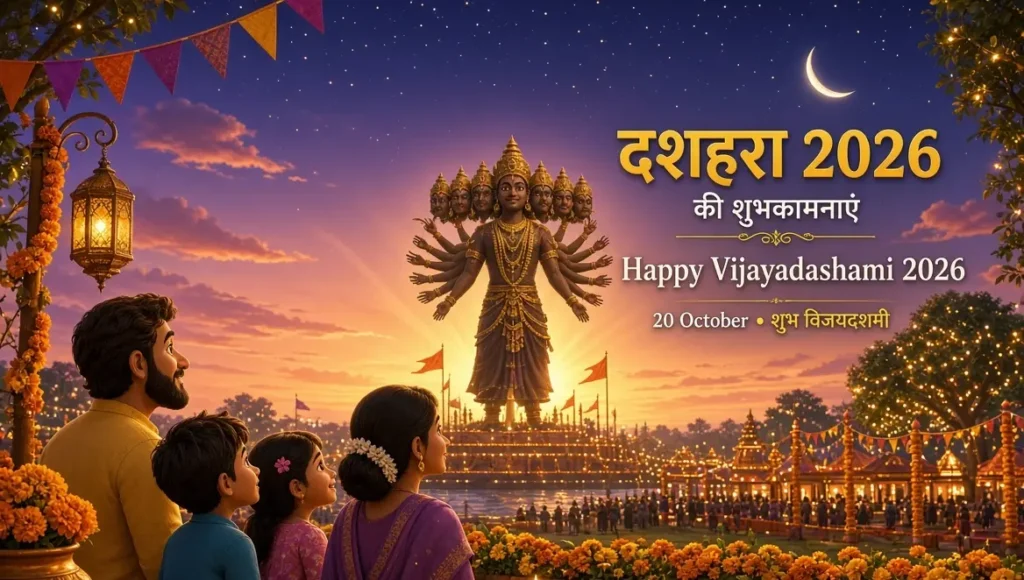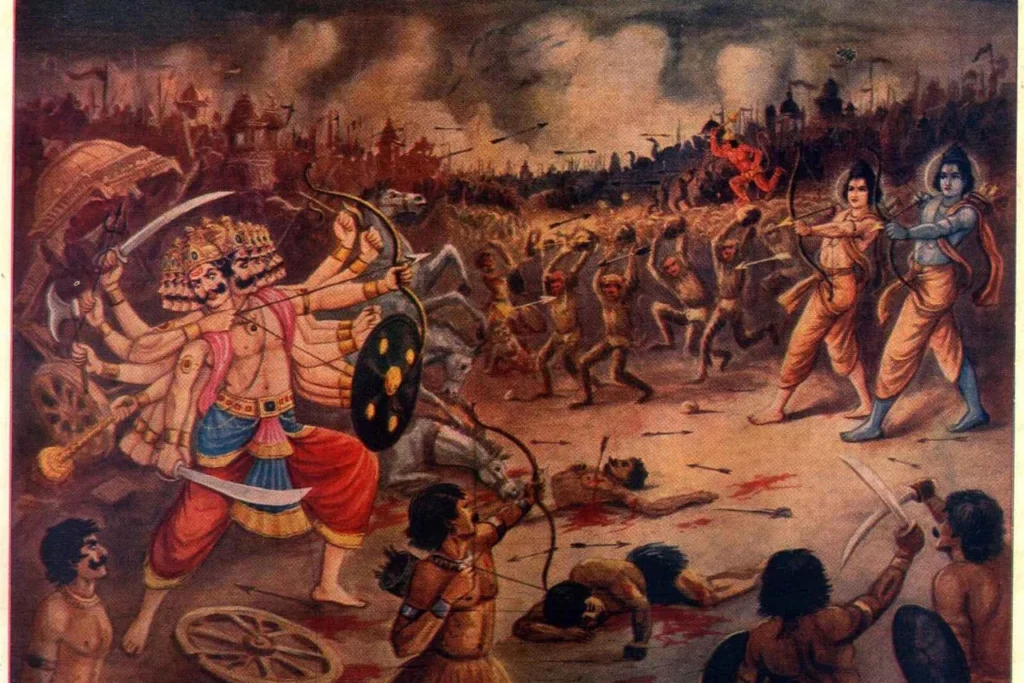
When you stand before a century-old lithograph showing Dashanana with ten crowned heads and twenty outstretched arms, a strange tension fills the frame. An old picture collection of Ravan reveals far more than a demon king; it preserves the tragic collision of supreme scriptural intellect and unyielding hubris.
Depicting Dashanana in Vintage Art: Grandeur and Nuance
Nineteenth-century lithographs never treated Ravan as a cartoonish villain. Classical Indian artists and printmakers rendered him as a peerless Vedic scholar adorned in gold ornaments, rich silks, and imperial finery. His multiple faces carried the focused intensity of an ascetic rather than mere monstrous rage.
Earth tones mixed with rich crimson and ultramarine dominated these vintage prints. The deliberate brushwork gave Lankan architecture an imposing grandeur, transporting viewers straight into epic antiquity without modern digital gloss.
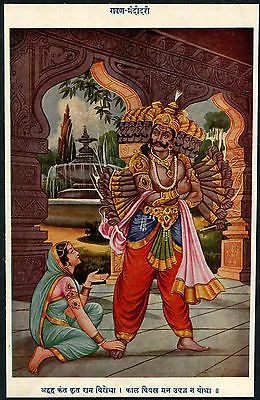
Mandodari’s Warning and Ravan’s Unbending Pride
Few palace scenes in classical print collections carry the emotional weight of Queen Mandodari pleading at her husband’s feet. Vintage compositions frame her figure bowing low, begging the king of Lanka to make peace with Shri Ram before absolute ruin strikes their golden realm.
Ravan stands immovable above her, his towering silhouette and golden crown emphasizing his stubborn delusion of invulnerability. It captures an eternal truth: when ego consumes intellect, even the wisest counsel sounds like faint noise against the palace marble.
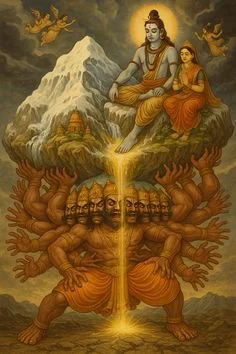
Lifting Mount Kailash: Devotion, Agony, and Tandava
The myth of Ravan lifting Mount Kailash remains one of Indian art’s most dramatic motifs. Older canvases position Ravan at the base, strain rippling through twenty muscular arms, while Lord Shiva and Goddess Parvati sit serenely above on snow-capped peaks.
As Mahadev gently pressed His toe down, crushing Ravan’s hands beneath the colossal mountain, sheer agony gave birth to supreme poetry. In that moment of crushed pride, Ravan sang the Shiva Tandava Stotram, turning raw desperation into immortal surrender.
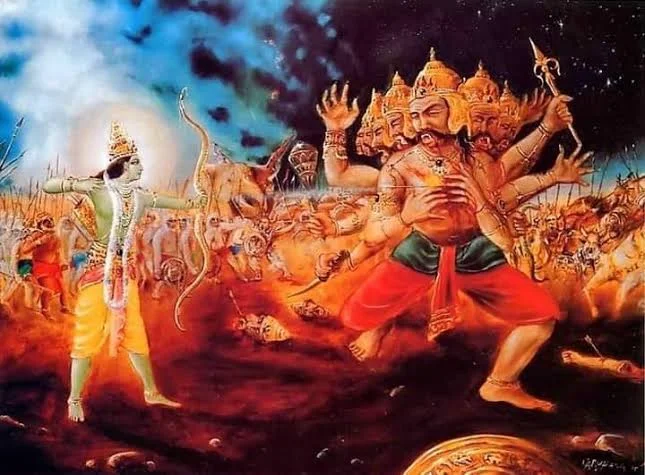
The Final Battlefield: Righteousness Against Raw Force
Battlefield lithographs from early presses do not shy away from grim epic scale. Darkened skies, broken chariots, and clashed celestial weapons form the backdrop for the final confrontation between a calm, poised Shri Ram and a roaring Lankan king.
These artworks freeze the exact moment Ram releases his divine arrow aimed at Ravan’s navel, shattering the secret nectar of his immortality. It served as a stark visual reminder across households that no degree of material power can survive against dharma.
The Dying King: Final Political Lessons to Lakshmana
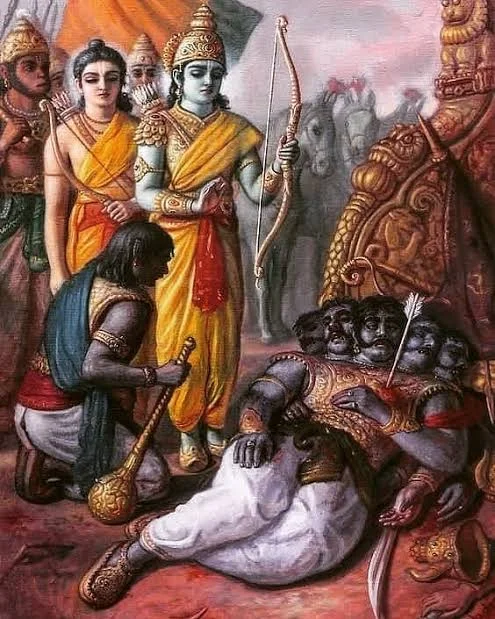
Perhaps the most touching vintage Ramayana composition depicts Ravan lying mortally wounded while Prince Lakshmana sits humbly near his feet. Shri Ram himself sent Lakshmana to receive the dying scholar’s final discourse on statecraft, ethics, and human nature.
With fading breath, Dashanana offered profound truths: never delay auspicious tasks, never underestimate an adversary, and guard crucial secrets. The artwork honors Ravan’s mastery of the Vedas and governance, proving that classical art recognized wisdom even in a fallen foe.
Historical and Spiritual Value of Vintage Epics Art
Exploring these archival prints is not just an exercise in religious devotion. They represent the golden age of Indian printmaking, influenced by pioneers like Raja Ravi Varma, who brought mythological storytelling onto paper for everyday households across the subcontinent.
These images remain mirrors for human nature. We carry both the virtue of Ram and the pride of Ravan within us. Knowledge and strength mean nothing without humility; vintage art preserves that balance for every generation willing to look closely.
Studying Ravan’s life through vintage art leaves you with an unavoidable mirror. Here was a man who mastered four Vedas and six Shastras, commanded planetary forces, yet brought absolute destruction upon his entire lineage because his intellect fed his arrogance instead of dissolving it.
When Lakshmana sat near the dying king’s feet, Ravan gave him practical rules for navigating the world: never put off good work, and never treat illness or enemies as insignificant. That deathbed scene reminds us that talent without self-restraint is just an elaborate trap.
In our own lives, achievements and degrees must never make us too proud to listen to honest counsel from those who care about us. True knowledge should soften a person from within, making them compassionate and grounded rather than defensive and unreachable.
Why is Ravan depicted with ten heads in vintage paintings?
The ten heads represent his formidable intellect, symbolizing complete mastery over the four Vedas and six Shastras, as well as his multifaceted personality and vast cosmic knowledge.
What did Lakshmana learn from Ravan on the battlefield?
Ravan advised Lakshmana never to delay auspicious actions, never to underestimate an enemy or an illness, and never to reveal personal vulnerabilities even to trusted companions.
What is the significance of the Kailash lifting scene in art?
It illustrates Ravan’s unmatched physical might alongside his ultimate submission before Lord Shiva, showing how divine grace transforms extreme ego into pure poetic devotion.
Why should vintage mythological prints be preserved today?
They are historical cultural treasures that document early Indian lithography, traditional artistic styles, and timeless philosophical lessons from the epics.