C. V. Raman Jayanti 2026: What Is the Raman Effect?
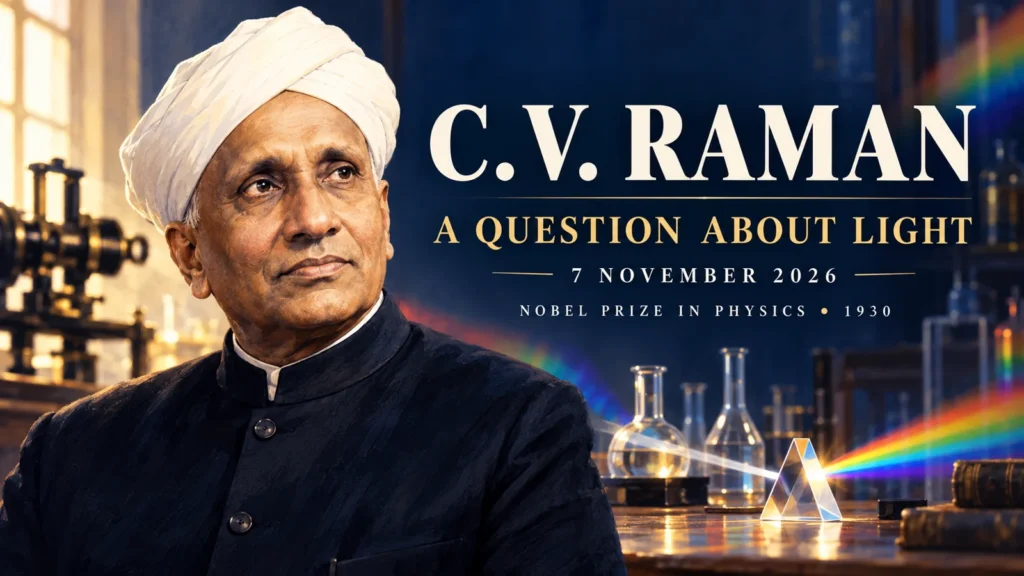
C. V. Raman’s birth anniversary falls on 7 November. Born on 7 November 1888 in Tiruchirappalli, Chandrasekhara Venkata Raman became an Indian physicist whose work on light scattering earned the 1930 Nobel Prize in Physics. For students, his legacy offers a useful lesson: an ordinary observation can become a scientific question when we investigate it carefully.
His birthday is different from National Science Day, observed on 28 February. This guide separates the dates, explains the Raman effect without advanced mathematics and provides a study chart and an original school speech.
Who Was C. V. Raman?
Raman was an Indian physicist whose interests included light and sound. His career is a reminder that scientific discovery involves observation, measurement and sustained work. A useful biography also recognises the research environment and contributions of collaborators rather than making discovery sound like an isolated moment of inspiration.
For a classroom introduction, keep three years on separate lines: 1888 for his birth, 1928 for the discovery associated with the Raman effect, and 1930 for the Nobel Prize. Students often remember the right names but attach them to the wrong dates. Raman died on 21 November 1970.
What Is the Raman Effect in Simple Words?
The Raman effect is a change in the frequency of a small fraction of scattered light when it exchanges energy with matter. Scattering means that light emerges in directions different from its incoming direction. A change of direction alone is not enough to identify Raman scattering: the photon’s energy, and therefore its frequency, must change.
Imagine light of one frequency reaching a sample. Most scattered light keeps its original frequency; this is Rayleigh scattering. A much smaller part exchanges energy with the material and leaves with a different frequency. That shifted part is Raman scattering. It would be incorrect to say that every photon changes colour after encountering a molecule.
An energy-accounting analogy helps. If the photon gives energy to the material, it leaves with less energy. If it gains energy from the material, it leaves with more. This analogy is about conservation of energy. It is not a literal picture of little coloured balls bouncing off stationary objects.
Rayleigh, Stokes and Anti-Stokes: What Is the Difference?
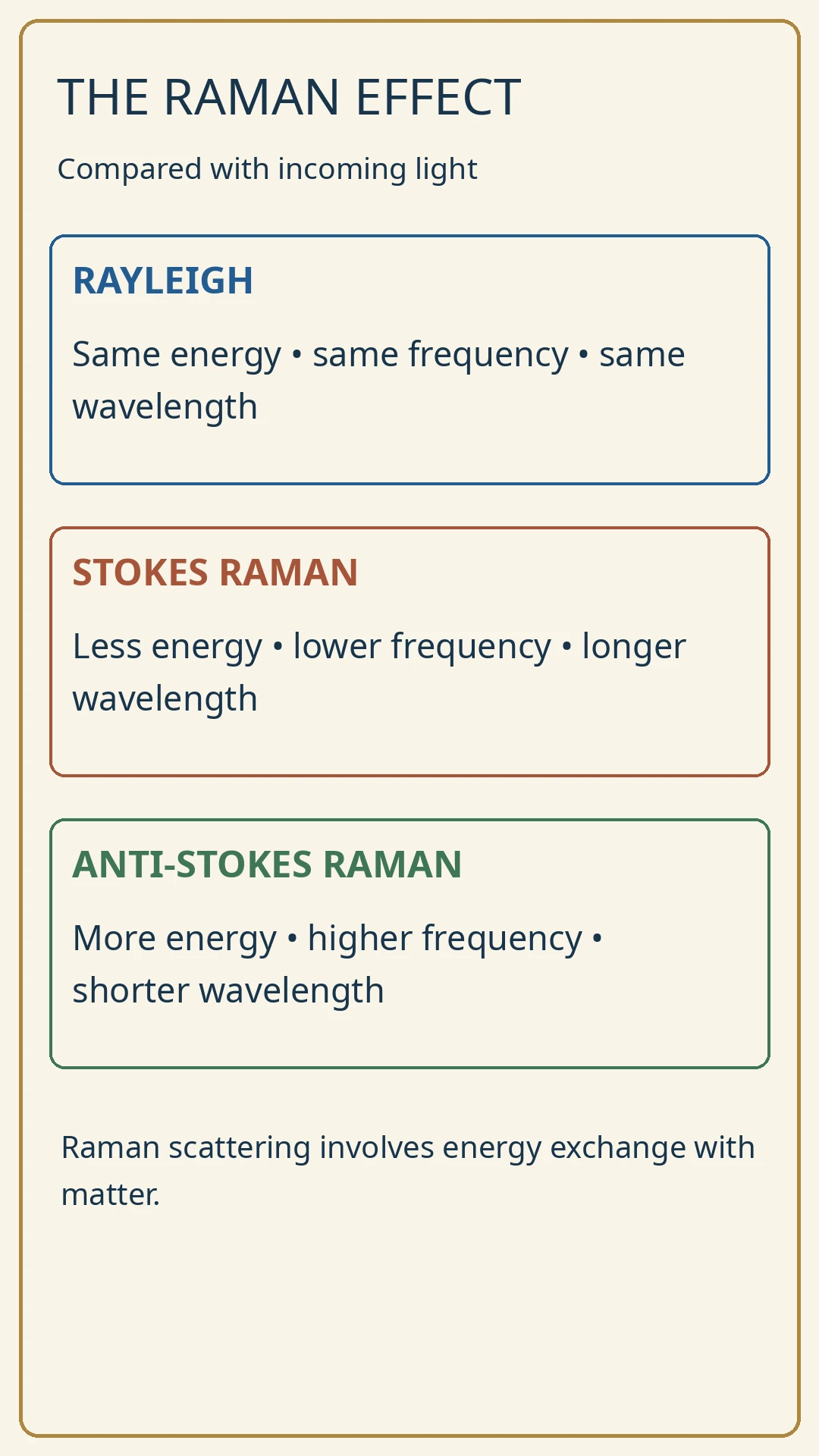
A photon with higher frequency has higher energy. For light compared in the same medium, higher frequency also means shorter wavelength. These relationships let us organise the three outcomes without memorising disconnected labels. The table below is an introductory comparison, not a full description of molecular spectroscopy.
| Scattering | Outgoing photon energy | Frequency and wavelength |
|---|---|---|
| Rayleigh | Unchanged | Both unchanged |
| Stokes Raman | Lower | Lower frequency, longer wavelength |
| Anti-Stokes Raman | Higher | Higher frequency, shorter wavelength |
Every comparison here is with the incoming light. Ask “lower than what?” whenever reading the chart. The answer is the incident photon, not another coloured arrow elsewhere in the picture. This small habit prevents confusion when the order of the rows changes in a textbook.
For a quick check, start from energy rather than the name. A photon that leaves energy behind must have less energy afterward. Its frequency is lower and its wavelength longer. That gives the Stokes result. Reverse the exchange and you obtain the anti-Stokes result.
Is the Blue Sea Simply an Example of the Raman Effect?
The colour of the sea is associated with popular accounts of Raman’s curiosity about light. However, saying “the sea is blue because of the Raman effect” is a misleading classroom shortcut. A discovery’s inspiration and the scientific definition of the discovered effect are separate questions.
NOAA explains the ocean’s blue appearance through water’s absorption of the red part of the light spectrum. Sediments and particles can also alter its appearance. Understanding the visible colour of a large body of water is therefore a different task from identifying frequency-shifted light in a Raman measurement.
Similarly, making a torch beam visible in milky water does not demonstrate the Raman effect. Seeing scattered light is different from measuring a very small frequency shift. A proper identification needs suitable equipment and analysis. Teachers can use the distinction to show why an attractive demonstration still needs an accurate explanation.
What Is Raman Spectroscopy Used For?
Raman spectroscopy studies the shifts in scattered light. Patterns in these signals provide information about a material’s structure and can help identify substances. The phrase “chemical fingerprint” is a useful analogy: a pattern assists identification, but interpretation still depends on context and proper analysis.
Material characterisation is one important application. At school level, the central idea is that scientists read measurable information carried by light rather than judging only brightness or visible colour. An ordinary photograph is not a Raman spectrum, and a colourful picture alone cannot establish a chemical identity.
For students in Madhya Pradesh: connect this topic with lessons on light, energy and matter. For MPPSC general-science revision, keep the scientist, discovery, award and physical principle as separate entries. There is no need to invent an MP birthplace or discovery location to make the article useful to local readers.
A productive revision exercise is to write two answers: a one-sentence definition for recall and a short explanation using energy exchange. The first helps with speed; the second checks whether the idea actually makes sense to you.
A Short School Speech and Classroom Activities
The following is an original speech sample for Raman’s birth anniversary.
Respected teachers and dear friends, on 7 November we remember the birth anniversary of C. V. Raman. His scientific work encourages us to ask questions and check our answers against evidence.
In the Raman effect, a small fraction of light scattered by matter changes frequency because energy is exchanged. This discovery helped deepen our understanding of light and matter. Raman received the Nobel Prize in Physics in 1930.
We can honour his legacy through a simple habit: before sharing a claim, ask what supports it. Science is more than remembering famous names. It also involves observing carefully, learning from others and correcting mistakes when new evidence appears. Thank you.
- Match three cards—7 November, 28 February and 1930—with their correct events.
- Use the chart to explain how a decrease in photon energy changes frequency and wavelength.
- Discuss what is wrong with the sentence “the sea is blue, so this proves the Raman effect.”
- Choose an everyday question and describe what evidence would help answer it.
Frequently Asked Questions
What is C. V. Raman’s full name?
Chandrasekhara Venkata Raman.
What is the Raman effect in one sentence?
It is the frequency shift of a small fraction of scattered light caused by energy exchange with matter.
Is National Science Day on 7 November?
No. Raman’s birthday is 7 November; National Science Day is 28 February.
When did Raman receive the Nobel Prize?
He received the Nobel Prize in Physics in 1930. The discovery year associated with the Raman effect is 1928.
Is Rayleigh scattering the Raman effect?
No. Rayleigh scattering preserves photon energy and frequency; Raman scattering changes them.
Study and Poster Advice
Write “lower energy—lower frequency—longer wavelength” together when revising Stokes scattering. Avoid attributing unsourced motivational quotations to Raman. Use your prescribed textbook for the terminology and depth required by your examination.
Educational introduction. Process illustrations are schematic and not drawn to scale.
Related reading
Sources
- Nobel Prize: C. V. Raman biography
- NCSM: National Science Day and Raman effect
- IIT / NPTEL: Raman scattering
- IIT / NPTEL: Raman spectroscopy
- NOAA: Why is the ocean blue?
- FBI research: Raman spectroscopy and molecular identification