 Vista
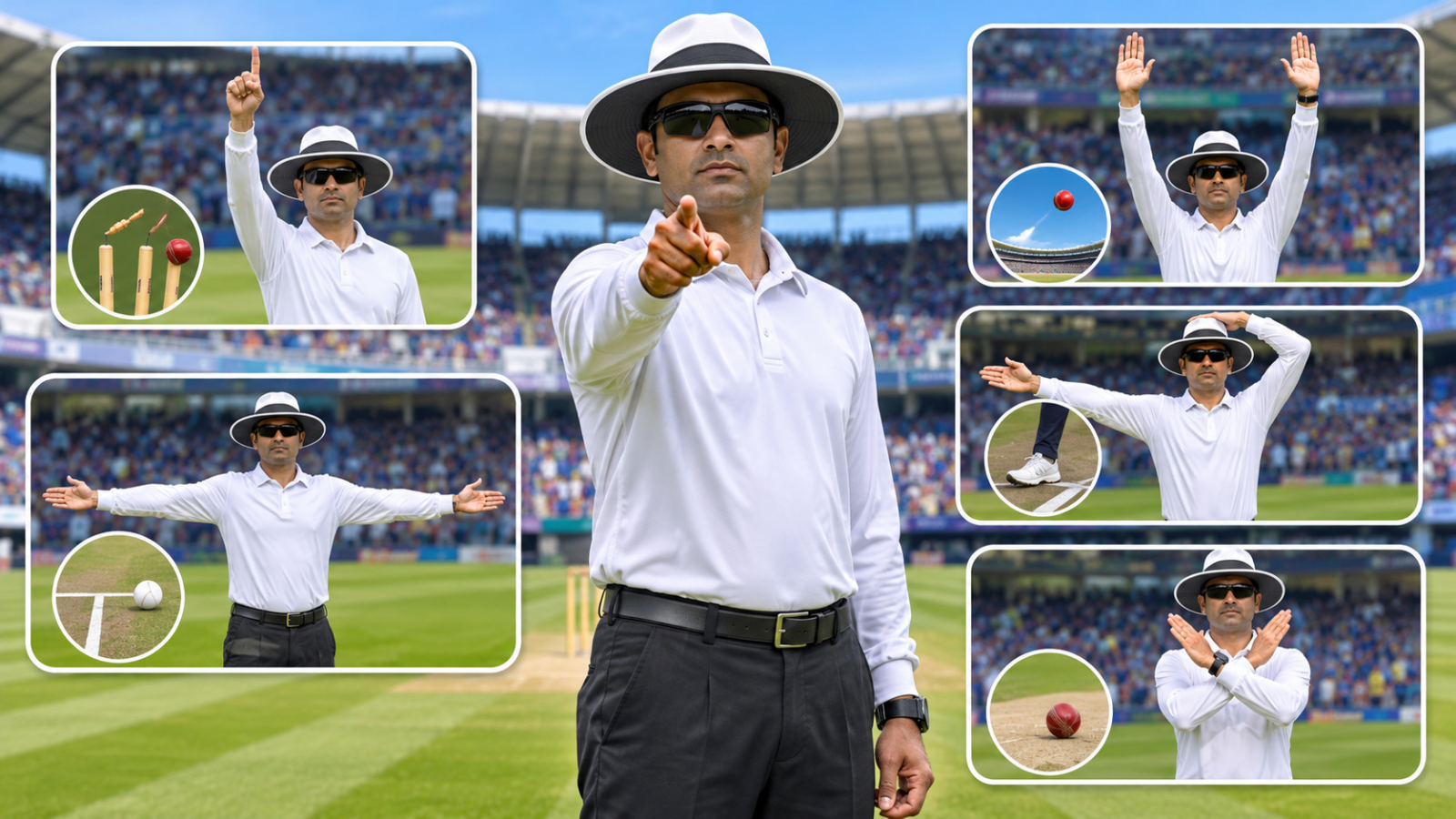
Looking for a cricket umpire signals chart with pictures? The important gestures are easy to recognise once you know the arm positions: finger up means Out, both arms sideways mean Wide, one arm sideways means No ball, both arms up mean Six, and a waving arm means Four. This visual-search-friendly guide explains the official MCC signals and common DRS confusion without mixing match-specific rules with the Laws of Cricket.
About the cover: The cover is editorial artwork. Its pointing gesture is not the Out signal, an umpire does not touch their hat for No ball, and Dead ball uses moving crossed wrists below the waist. The written chart reflects the MCC rules.
Cricket umpire signals chart: the quick answer
Cricket umpire signals are standard gestures that communicate decisions to players, scorers and spectators. An index finger raised above the head normally signals Out. Both arms extended horizontally indicate Wide; one arm horizontally indicates No ball. Four is communicated by waving an arm across the chest, while Six uses both arms raised above the head. These signals are described in Law 2.13 of the MCC Laws of Cricket, including the 2026 edition. A clear chart with pictures should show not just the pose but what each signal means for the score, whether the ball remains in play and whether batters can be dismissed. This guide explains the major gestures, common broadcast misunderstandings, and how match-specific playing conditions add technology-related signals.
Out: one raised index finger
For an out decision, the umpire raises an index finger above the head. This is the iconic cricket dismissal signal. It follows an appeal and a decision according to the relevant law; a player is not out merely because a spectator thinks the catch was clean. The umpire’s finger means the on-field decision is Out, subject to review procedures where those apply. A dismissal can be caught, bowled, LBW, run out and other forms, each with different legal conditions. The finger gesture does not itself reveal which dismissal happened. Look at the scorecard or broadcast graphic for that detail. If the umpire decides Not out, the official response is a call rather than a raised-finger dismissal gesture.
Wide: both arms horizontally stretched
The Wide signal is given by extending both arms horizontally to the sides. A delivery is not Wide simply because it passes outside a painted line; the striker’s position, normal batting stance and playing conditions matter. A Wide generally adds an extra to the batting side, subject to the scoring laws, and the ball is not counted as one of the over’s valid deliveries. If a wicket falls or batters run, the final scoring may require more explanation than a single Wide extra. In limited-overs cricket, umpires may apply particular guidance to the wide line, but the general principle remains that the delivery is judged against the applicable playing conditions. Do not confuse a Wide with the separate No-ball signal.
No ball: one arm extended horizontally
For No ball, the umpire extends one arm horizontally. This can arise from a front-foot fault and other circumstances set out in cricket law. It adds a penalty run and usually does not count as a legal ball of the over. The batter’s possible dismissals on a No ball are restricted by the laws, which makes this signal strategically important. In some limited-overs formats, certain No balls are followed by a Free Hit under the competition’s playing conditions. Do not assume that every cricket match uses an identical Free Hit rule. The signal for No ball itself is not the same as a television replay graphic marking the bowler’s foot. Understanding that distinction helps viewers follow revised decisions.
Four: an arm waved across the chest
The umpire signals a boundary Four by waving an arm from side to side, finishing with the arm across the chest. A ball does not need to bounce exactly once to count as Four; the relevant issue is how the ball reaches or crosses the boundary and how the law applies. A ball that has touched the ground before clearing the boundary normally scores Four, while one that clears it without having touched the ground after the striker’s hit can qualify for Six. If there are overthrows or unusual deflections, the scoring may involve other laws. The signal is given to inform scorers once the ball is dead under the required timing rules. A wide sweeping arm motion is not a Wide signal.
Six: both arms straight above the head
For Six, both arms are raised vertically above the umpire’s head. A hit that carries over the boundary without bouncing within the field ordinarily earns Six, subject to rules on the boundary, catches and exceptional situations. Viewers sometimes mistake the signal for an instruction to players because both hands are raised. The difference is the straight-up posture, compared with the side-to-side horizontal Wide gesture. Ball tracking graphics and television commentators do not replace the umpire’s formal communication to scorers. A spectacular catch attempt at the rope can make the decision more complicated: where the fielder and ball were in relation to the boundary is crucial.
Bye and leg bye: different from boundaries
A Bye is signalled by raising an open hand above the head. A Leg bye is signalled by touching a raised knee with the hand. These extras occur where runs are scored without a normal credited contact off the bat, but eligibility conditions differ. In particular, not every pad deflection automatically deserves Leg byes; the Laws address whether the striker attempted to play the ball or avoid being hit. The scorer uses the umpire’s signal to put runs in the appropriate extras column rather than crediting the striker with runs off the bat. They matter in close matches, and seeing the correct gesture can explain why a total rises without the batter’s individual score changing.
Dead ball, short run and penalty-run gestures
Dead ball is signalled by crossing and recrossing the wrists below the waist. Once a ball is dead, play on that delivery has legally ended, and the particular circumstances determine what happens next. For Short run, the umpire bends one arm up and touches the nearer shoulder with their fingertips to indicate that a run was not completed properly. Penalty-run signals may involve repeated tapping or other defined gestures depending on the infringement and which team receives the runs. These are less familiar because they appear less often on ordinary highlights, but they are essential for interpreting unusual score changes. Learn the exact official gesture from MCC Law 2.13 instead of relying on unofficial social media infographics that sometimes swap the pictures.
Third umpire and DRS: what the TV gesture means
Technology-related signals often appear in international matches using Decision Review System protocols. The familiar rectangle traced with the hands signals a request for a television review or referral under the relevant playing conditions. It should not be confused with the basic out, wide or no-ball signals in MCC Law 2.13. DRS availability differs by format, competition and equipment. The television umpire can review different issues according to specified procedures; not every call can be challenged in every tournament. An on-field decision may be upheld or changed after a review, but fans should look for the official decision rather than treating an early broadcast replay as final. There may also be separate official signals for the result of a review under international playing conditions.
Under the October 2026 ICC men’s ODI conditions, a player requests a Player Review with a T made from both forearms at head height, generally within 15 seconds of the ball becoming dead. The on-field umpire uses the TV rectangle to refer the decision. In the ICC men’s T20I conditions, all forms of No ball trigger a Free Hit. After the No-ball signal, the umpire raises one arm and moves it in a circle. See the ICC playing conditions for the applicable format.
How to read an umpire signals picture chart correctly
Start by comparing arm direction and hand shape: one finger vertical for Out, one arm horizontal for No ball, both arms horizontal for Wide, both arms vertical for Six, moving arm across the chest for Four, raised open palm for Bye and hand to raised knee for Leg bye. For Dead ball, look for crossed moving wrists below the waist. A photo capturing one moment of a movement can mislead; motion-based gestures are better explained with a sequence of pictures or short annotations. It is also useful to label whether the signal changes runs, the delivery count or the dismissal outcome. A signal chart for school projects should not use a photo of a player appealing as an example of the umpire calling Out.
School projects and beginners: use the chart safely
For a sports chart, draw a simple stick-figure umpire in an official outfit and show one gesture per panel. Write the name and scoring consequence below, for example ‘No ball: one arm sideways; an extra and normally not a legal delivery’. Keep Free Hit and DRS in a separate section marked ‘competition rules’, because they are not universal across every match. Teachers can ask children to match gestures to words or identify the differences between Wide and Six. A printable worksheet is useful, but always cross-check the drawings with the official MCC signals text. If an image generator makes fingers, arms or movements inaccurate, correct the diagram before treating it as an educational reference.
MCC signals at a glance
- Out — Raise one index finger above the head
- Wide — Extend both arms horizontally
- No ball — Extend one arm horizontally
- Four — Wave an arm sideways, ending across the chest
- Six — Raise both arms above the head
- Bye — Raise an open hand above the head
- Leg bye — Touch a raised knee
- Dead ball — Cross and recross the wrists below the waist
- Short run — Bend an arm up and touch the nearer shoulder with the fingertips
Frequently asked questions
Which signal means Out? One index finger raised above the head.
What is the difference between No ball and Wide? One extended horizontal arm versus both horizontal arms, with different underlying rules.
Why are both hands raised? Two vertical arms signal Six; two horizontal arms mean Wide.
How does an umpire signal Four? By waving an arm across the chest.
Is drawing a TV screen a universal cricket signal? It relates to review protocols used in particular competitions.
Where are the official signals listed? MCC Laws of Cricket, Law 2.13.
Official source: MCC Laws of Cricket (2026), Law 2.13 — Signals. Checked 16 November 2026.
Image note: The featured illustration is a conceptual visual reference; use the written definitions and MCC’s original signal diagrams when accuracy matters for exams or umpiring.
Conclusion: Identify finger, hand and arm positions first, then check the scoring consequences and any match-specific playing conditions.
Related reading · Hong Kong Sixes 2026: India’s Next Match, IST Schedule and Cup Format Explained

















Share Your Opinion
Comments are closed on this post.