
Green energy stocks India: five businesses to research before BRE Summit 2026
India’s clean energy summit can draw attention to renewable energy shares, but an event is not an earnings guarantee. This green energy stocks India watchlist compares Tata Power, Suzlon Energy, Adani Green Energy, NTPC Green Energy and Waaree Energies across different parts of the industry. The useful question is which business can turn demand into cash flow at a reasonable valuation.
Research date: October 27, 2026. Five-company educational watchlist; no buy ranking, live prices or return targets.
What the renewable energy summit could actually change
The Bharat Renewable Energy Summit & Expo is scheduled for November 2–5, 2026 at Bharat Mandapam, New Delhi. Official announcements describe a platform for investment, policy and technology collaboration. Read our Hindi guide to the summit’s dates, themes and registration for the event background.
Our analysis: New procurement plans or binding contracts could matter to individual companies. A speech, exhibition appearance or memorandum of understanding is weaker evidence than an executable order with commercial terms. This article does not claim that any of these five companies will receive a summit contract or that their shares will rise because of the event.
| Company | Exposure to research | Main question |
|---|---|---|
| Tata Power | Diversified power and renewable businesses | Does expansion improve returns after capital spending? |
| Suzlon Energy | Wind equipment and services | Do orders convert into deliveries and cash? |
| Adani Green Energy | Renewable generation and storage | Can growth be funded sustainably? |
| NTPC Green Energy | Renewable project development and operations | Does the pipeline reach commercial operation on time? |
| Waaree Energies | Solar manufacturing | How resilient are margins and capacity utilisation? |
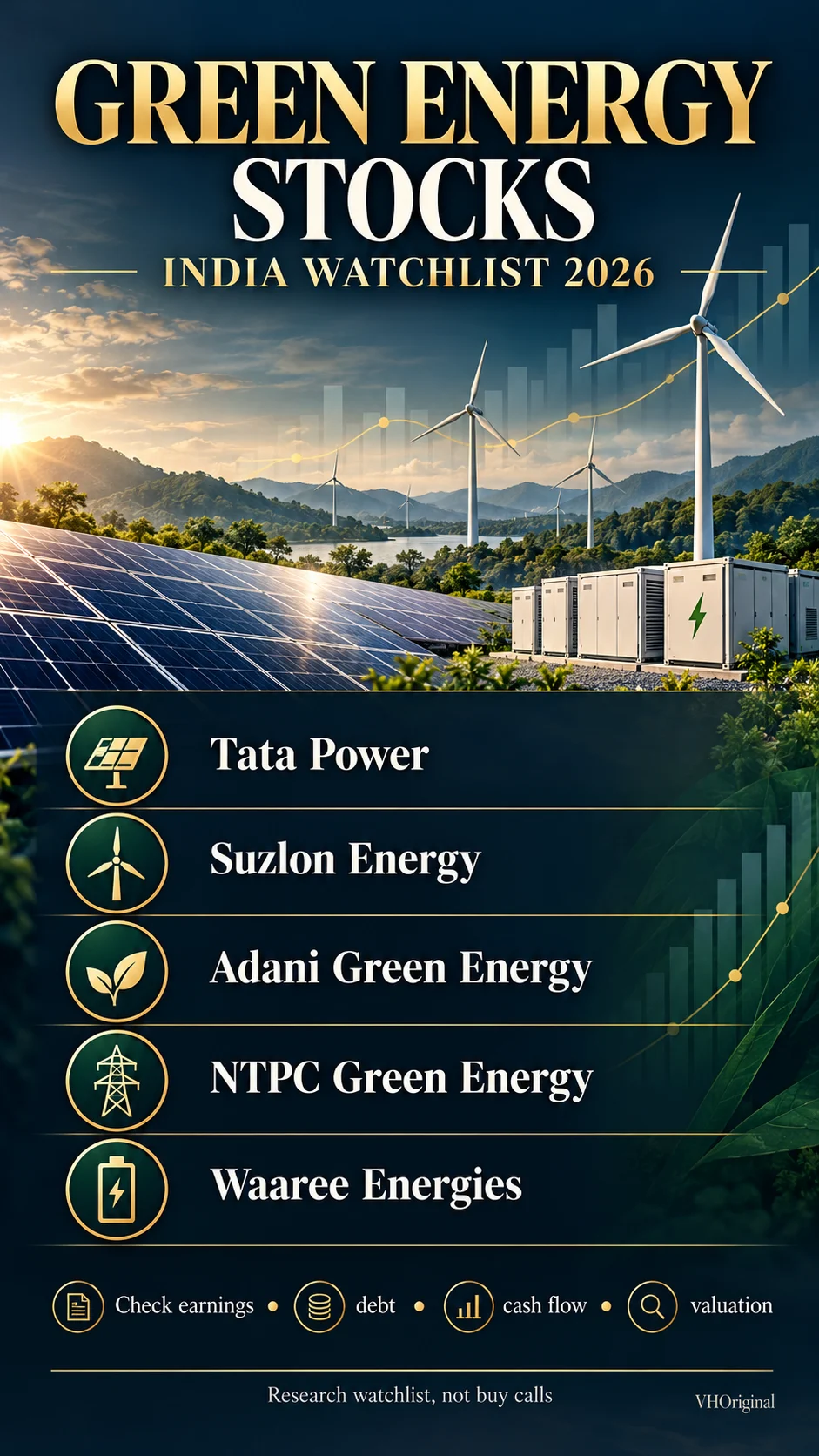
1. Tata Power: diversification alongside renewable execution
Tata Power combines renewable activities with other power businesses, so it should not be valued as a pure solar generator. Its subsidiary TPREL reported on October 12 that Q2 FY27 execution included 419 MW of utility-scale projects and 131.2 MWh of storage projects. Those figures describe different measures: MW is power capacity and MWh is energy storage capacity.
Research lens: Check segment earnings, project commissioning and capital expenditure together. Our assessment is that diversification broadens the business exposure, while funding requirements and execution across several businesses still need scrutiny. Growth in installed assets alone does not establish an attractive share price.
2. Suzlon Energy: order conversion matters more than headlines
Suzlon’s official media page lists a September 8, 2026 announcement of a 200 MW order from Ayana Renewable Power, following other wind-order announcements during the year. An announced order is not the same as revenue collected, and quarter-end order-book figures need their own reporting date.
Research lens: Track deliveries, commissioning, receivables and operating cash flow. For a turbine supplier, land readiness, customer execution and transport constraints can affect the timing of activity. Compare margins over several reporting periods rather than treating one large contract as an immediate profit increase.
3. Adani Green Energy: scale, storage and financing
In its October 21 H1 FY27 release, Adani Green reported operational renewable capacity of 20.8 GW and energy sales of 25,747 million units. The company also reported net debt to run-rate EBITDA of 5.6 times. These are company-reported measures; the definition of run-rate EBITDA should be read alongside the financial statements.
Research lens: Compare debt maturities, financing costs and cash generated by operating assets with planned expansion. Storage and generation growth can create opportunities, but transmission availability, project execution and financing terms can affect the return ultimately earned by shareholders.
4. NTPC Green Energy: pipeline versus commissioned assets
NGEL describes itself as the umbrella for NTPC’s green business initiatives, with projects undertaken through organic and inorganic routes. Its official company pages cover renewable projects and related areas such as storage and green hydrogen. Parent-group ambitions should be distinguished from assets owned and operating within the listed company.
Research lens: Read consolidated disclosures and joint-venture details. Separate operational capacity, awarded projects and development plans. Check commissioning schedules, power-purchase terms and funding commitments; a large pipeline does not yet produce the cash flow of a commissioned plant.
5. Waaree Energies: manufacturing is a different investment case
Waaree Energies’ investor portal provides financial statements and company disclosures. Use the exact listed entity when reviewing those documents: Waaree Energies and Waaree Renewable Technologies are separate companies, and their results should not be mixed.
Research lens: For solar manufacturing, examine utilisation, realised selling prices, material costs, working capital and the geography of demand. Expansion may increase sales capacity while competition or changing trade rules affect margins. Read the latest published results before making a valuation comparison; this article does not assign a current earnings multiple.
Technical analysis: what to check on a dated chart
No verified daily price series is reproduced here, so this article does not invent RSI readings, moving-average values, breakout levels or stop-loss prices. A useful chart review would record the exchange, date and adjusted-price basis, then compare the price with its 50-day and 200-day moving averages, recent trading ranges and volume.
A higher-volume move above a prior range can be a signal to investigate, not proof of a sustained rally. Confirm whether a corporate action has changed the chart. Any trading rule also needs a clear invalidation condition and position-size limit; technical indicators cannot remove loss risk.
How to assess the best renewable energy stocks to buy
There is no universal best stock for every investor. Start with the business model, then assess cash conversion, leverage, valuation and concentration risk. A strong sector outlook can coexist with an expensive share price. Likewise, a growing order book may require substantial working capital before it produces cash.
After the summit, compare the actual company disclosure with the claim circulating online. Check the order value, execution period, counterparty and conditions. For the wider market context, see our US midterms and Indian stock market analysis.
Frequently asked questions
Will renewable stocks rally after BRE Summit 2026?
No. Prices also depend on expectations, earnings, valuations and broader markets. The event alone cannot establish a return forecast.
Are these five stocks ranked?
No. They illustrate different businesses in the renewable energy value chain, not a best-to-worst list.
Is a large order book enough?
No. Execution, margins, cancellations, payment terms and cash collection matter.
Does a renewable portfolio number mean operating capacity?
Not necessarily. A portfolio can include projects at different stages; check the company’s definition and reporting date.
Sources and investment note
Primary sources: PIB summit announcement; Tata Power, October 12 update; Suzlon announcements; Adani Green H1 FY27 release; NGEL company information; Waaree Energies financial disclosures.
Educational research, not personalised investment advice or a recommendation to transact. Company statements are attributed; research questions are editorial analysis. Verify the latest filings and prices independently. Images are AI-generated conceptual illustrations.