Jio IPO GMP Today: Read the quote before the headline
Searching for Jio IPO GMP today does not tell you what price your shares will actually fetch. You need the date of the quote, the issue-price basis and the number of shares allotted to you. A projected price such as ₹1,363 is a calculation, while the exchange opening price is a market outcome.
Verification note — 27 October 2026: The directly readable Economic Times report checked for this article was updated on 24 October at 11:42 AM IST. It reported an unofficial premium of ₹250 per share. We have not independently verified a fresh, timestamped 27 October quote. That older figure is used below as an attributed snapshot, not a live GMP feed.
Jio Platforms expected listing price: the starting numbers
Zerodha’s issue page lists a ₹1,065–₹1,119 price band, a 12-share lot and a tentative listing date of 28 October 2026. We use ₹1,119 as the calculation basis. Match the actual price paid, any eligible discount and allotted quantity against your own allotment advice before calculating your return.
The issue price belongs to the public offer. The grey market premium is an unofficial amount quoted above that basis. Neither determines the exchange opening price: actual market buying and selling interest can produce a different outcome.
Why do ₹1,363 and ₹1,369 both appear in calculations?
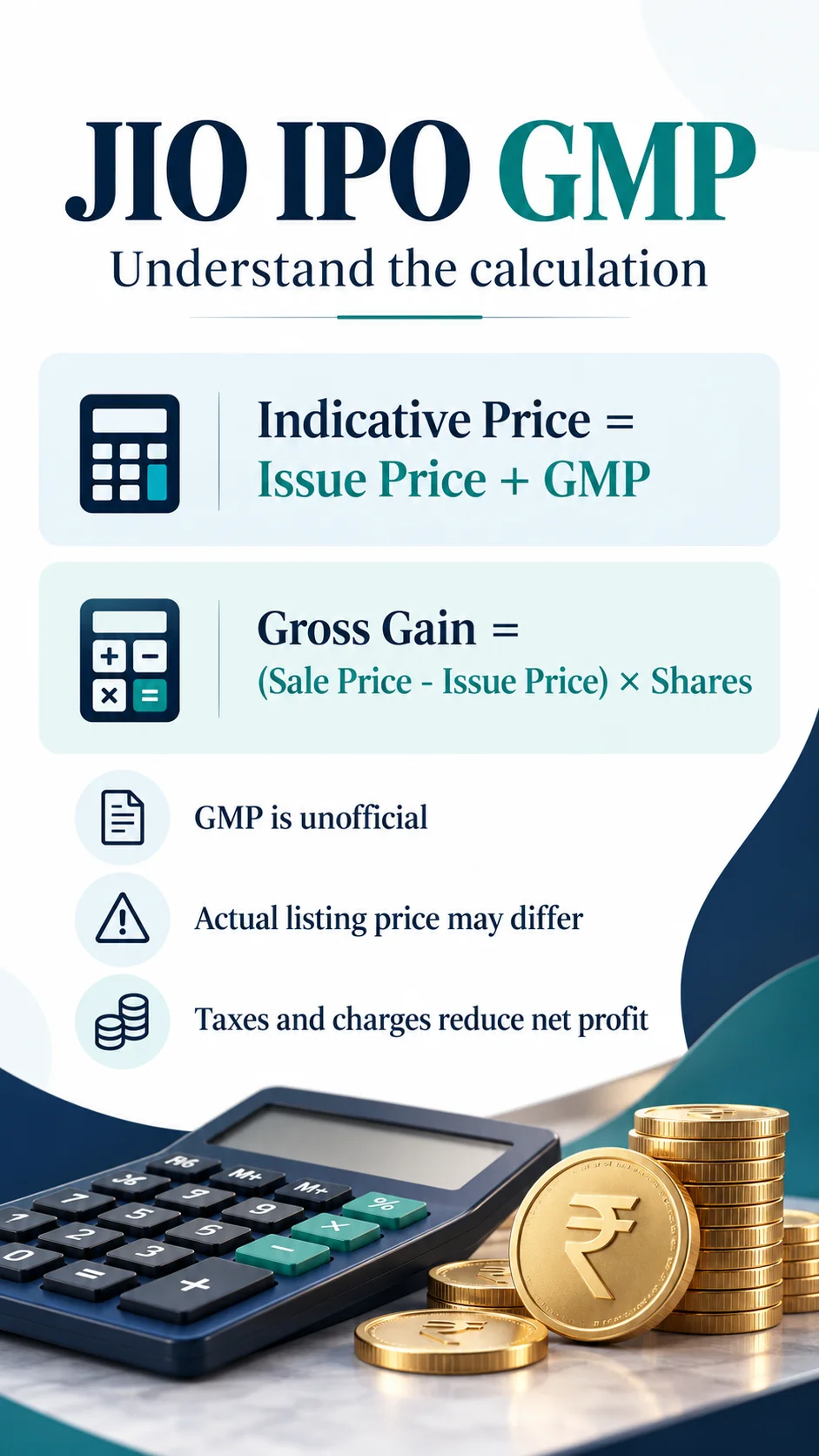
Indicative price = issue-price basis + quoted GMP. Adding the dated report’s ₹250 premium to ₹1,119 gives ₹1,369, or approximately 22.34% above the basis. This is arithmetic using that report, not a confirmed debut price.
A ₹1,363 illustration instead assumes a ₹244 premium: ₹1,119 + ₹244 = ₹1,363. We have not verified ₹244 as the current GMP. It is included only to explain the number in the original article brief. Different quotes, publication times or assumptions lead to different implied prices.
| Basis | Indicative price | Gross difference on 12 shares |
|---|---|---|
| ₹1,119 + ₹250: dated 24 October report | ₹1,369 | ₹3,000 |
| ₹1,119 + ₹244: illustrative assumption | ₹1,363 | ₹2,928 |
| ₹1,119 + ₹0: illustrative assumption | ₹1,119 | ₹0 |
FACT BOX: An indicative premium percentage is not a realised net return. The actual sale price, the number of shares sold, charges and applicable taxes determine the final outcome.
Profit calculation for 12, 36 and 60 shares
Suppose shares were allotted at ₹1,119 and were later actually sold at ₹1,369. The gross difference would be ₹250 per share. The following table shows conditional examples; it does not predict a sale price or promise allotment of these quantities.
| Shares actually allotted and sold | Cost at ₹1,119 | Sale value at ₹1,369 | Gross difference |
|---|---|---|---|
| 12 | ₹13,428 | ₹16,428 | ₹3,000 |
| 36 | ₹40,284 | ₹49,284 | ₹9,000 |
| 60 | ₹67,140 | ₹82,140 | ₹15,000 |
Use allotted and sold quantity, not applied quantity. An application for five lots followed by an allotment of one lot means the calculation starts with 12 shares. If only some shares are sold, the realised result applies to those shares; the remaining holding continues to fluctuate.
Net proceeds also depend on applicable brokerage, exchange and regulatory charges, STT, GST, DP charges and taxes. Their application depends on the broker and transaction. These examples therefore show gross arithmetic, not a personalised after-tax payout.
What if the debut is weaker than the GMP suggests?
With the same ₹1,119 basis and 12 shares, an actual sale at ₹1,100 would produce a ₹228 gross loss. Selling at ₹1,000 would produce a ₹1,428 gross loss. Charges may increase the loss. These examples make clear why an old positive premium cannot eliminate downside risk.
A news report captures a quote at a particular time. Subsequent developments, broader market sentiment and selling interest can change the outcome. Strong subscription does not guarantee buying demand at every possible listing price.
What to check before listing day
Confirm your actual allotment and demat credit first. Our Hindi Jio IPO allotment-status guide explains the registrar and BSE checks. A bank mandate or blocked balance alone does not prove that shares were allotted.
For offer documents, visit Jio’s IPO investor-relations page and check NSE issue information. For background on the application process, see our Jio IPO application and shareholder-quota explainer.
Advice: Separate a price estimate from an investment decision
Whether to sell after listing or keep a holding depends on your financial needs, risk tolerance and assessment of the business and valuation. An unofficial premium alone is a weak basis for borrowing to invest or assuming a fixed listing-day payout. This article provides no buy/sell target.
FAQ: Jio IPO GMP and listing gains
Is ₹250 the confirmed GMP for today?
No. Here it is the figure reported by ET on 24 October 2026 at 11:42 AM IST. A fresh 27 October quote has not been independently verified.
Is a ₹1,369 listing guaranteed?
No. It is the sum of a ₹1,119 basis and the dated ₹250 premium. The actual exchange price can differ.
How is the ₹1,363 example calculated?
By adding an illustrative ₹244 premium to ₹1,119. It is not presented as a verified current quote.
When would one lot produce a ₹3,000 gross gain?
If 12 shares were acquired at ₹1,119 and all 12 were actually sold at ₹1,369, before charges and applicable taxes.
Does GMP confirm allotment?
No. Check the registrar’s allotment record and your demat credit. A grey-market quote is not evidence of shares in your account.
Disclaimer: This independent article contains educational calculations, not personalised investment advice. Source dates are identified above; this page has no live GMP feed. Investing can result in loss of capital.