 Vista
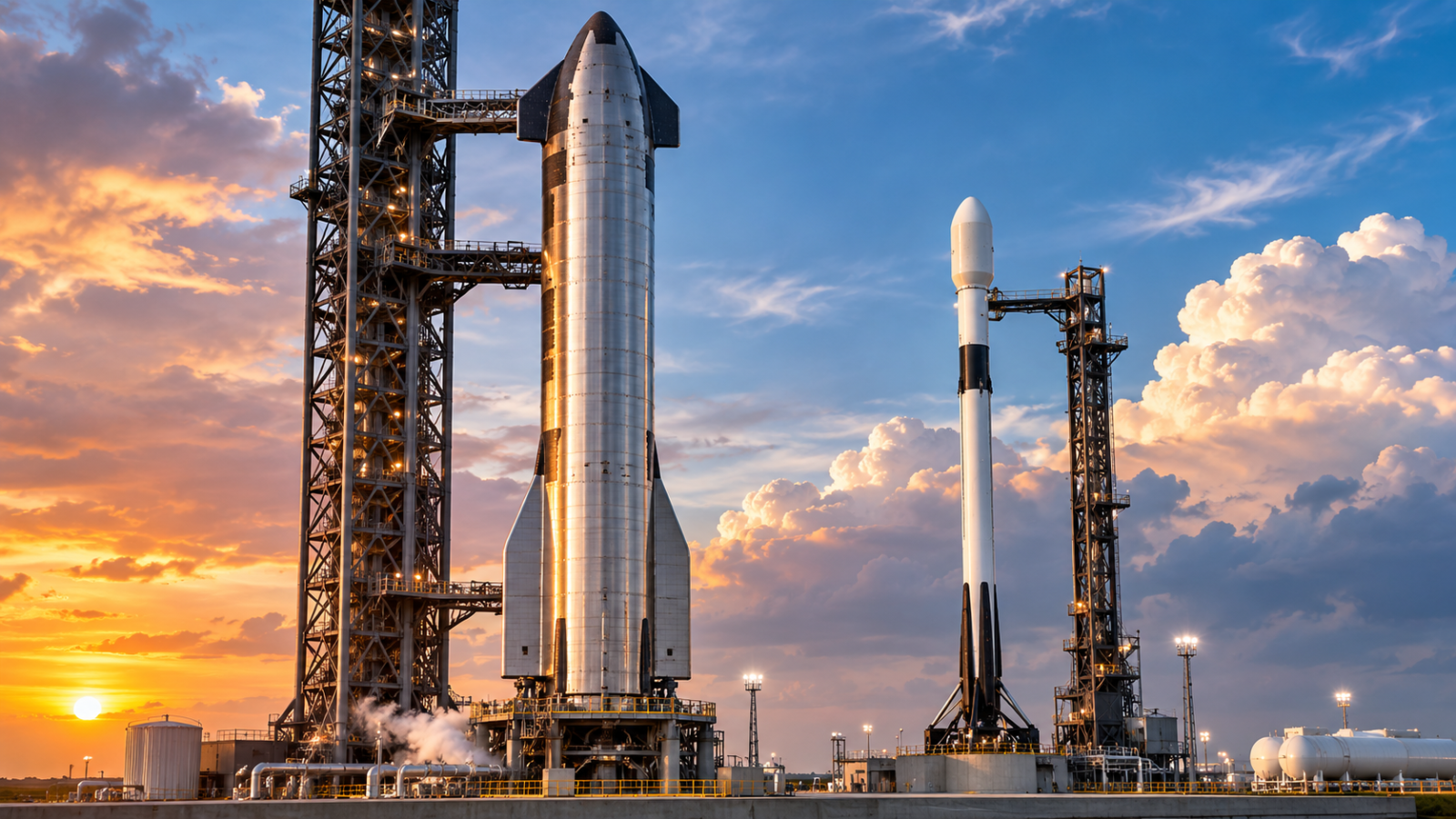
Starship vs Falcon 9 is more than a comparison of two SpaceX rockets. Falcon 9 is a proven workhorse built around reusable first-stage launches. Starship is a far larger system designed for recovering both stages and carrying much heavier payloads. Here is a fact-checked guide to their size, Merlin and Raptor engines, fuel, payload capacity, landing methods, real missions and what remains a development goal as of November 2026.
SpaceX’s September 28 Flight 14 was an orbital flight test. Its mission report documents the test objectives and outcomes. Falcon 9, meanwhile, carried Crew-13 to the ISS in October; Starship’s routine passenger service, both-stage reuse and payload targets remain separate questions. SpaceX Flight 14 · SpaceX Crew-13.
Starship vs Falcon 9: the key difference
Starship and Falcon 9 are both SpaceX launch systems, but they were developed for different scales of work. Falcon 9 is a widely used two-stage orbital rocket that routinely flies operational missions and recovers its first-stage booster. Starship combines a much larger Super Heavy booster with a Starship upper stage and is designed for full-system reusability, very large cargo deliveries and ambitious destinations including the Moon and Mars. SpaceX lists Falcon 9 at about 70 metres tall with a 3.7-metre main-body diameter and a listed low-Earth-orbit payload of 22,800 kilograms. It lists the Starship/Super Heavy system around 124 metres tall, 9 metres in diameter and designed for more than 100 metric tonnes of payload in a reusable configuration. Design capability and repeatedly demonstrated operational capability are not the same, and comparisons must keep them separate.
Size comparison: how much bigger is Starship?
Falcon 9’s slender 70-metre vehicle is already taller than many city buildings. The full Starship system is roughly 124 metres high, so it towers over Falcon 9. Diameter is an even bigger practical difference: Falcon 9 is 3.7 metres across through its main body, whereas Starship is 9 metres across. That wider cross-section provides room for much larger propellant tanks and a broader payload compartment, but it also increases the challenges of structural loads, transport, pad integration and handling. A scale comparison picture should show both rockets standing on a common baseline; placing two unrelated launch photographs side by side without aligning scale can exaggerate or minimise the difference. The measurement may vary slightly by version, so read the current vehicle specifications rather than assuming one prototype’s dimensions never change.
Engine technology: Merlin versus Raptor
Falcon 9’s first stage uses nine Merlin engines, and its second stage uses a Merlin Vacuum engine. They burn refined kerosene known as RP-1 with liquid oxygen. Starship’s Super Heavy booster uses an array of Raptor engines—SpaceX’s published overview describes 33 engines in the booster design—while the Starship upper stage uses vacuum-optimised and sea-level Raptor variants. Raptors are designed for liquid methane and liquid oxygen. Different fuels and engine cycles influence plumbing, combustion, refurbishment and future operating plans. The number of engines does not by itself reveal launch reliability, efficiency or passenger safety. Rocket engineers also compare thrust, specific impulse, engine-out capability, propellant storage and the complexity of controlling multiple engines. Numbers can evolve as Starship versions and tests develop.
Why do the rockets use different fuels?
Falcon 9’s RP-1 kerosene and liquid oxygen combination supports a mature operational architecture built around the Merlin engine family. Starship’s methane and oxygen combination is part of an architecture designed for repeated use and future deep-space systems. Methane has different combustion and handling characteristics from RP-1, though both require sophisticated cryogenic oxidiser systems. SpaceX has also discussed methane-based propellant production as relevant to Mars ambitions. This is an engineering design goal, not proof that practical refuelling plants are operating on Mars today. Fuel choice affects more than the rocket engine: it influences tanks, ground equipment, seals, thermal management, mission design and maintenance. A straightforward comparison should avoid saying one fuel is simply ‘better’ in every context.
Payload capacity: 22.8 tonnes versus 100+ tonnes
The Falcon 9 vehicle page lists a maximum low-Earth-orbit payload figure of 22,800 kg, while SpaceX presents Starship as designed for more than 100 metric tonnes in a fully reusable configuration. Those figures describe different performance assumptions and should not be treated as a confirmed head-to-head test using identical destinations, recovery conditions and payload hardware. Actual capacity depends on orbital altitude, inclination, launch profile, booster recovery strategy and the particular vehicle configuration. Falcon 9 has extensive experience with satellites, crewed Dragon flights and cargo missions. Starship’s larger cargo bay is aimed at different payload sizes and mission architectures, including potential large satellite batches and future deep-space logistics. A bigger stated payload figure is meaningful only together with operational readiness and mission requirements.
Reusability: what is recovered today and what is planned?
Falcon 9’s key commercial breakthrough is the repeated recovery and reuse of its first stage. The second stage is not routinely brought back for reuse as part of that operational architecture. Starship is designed around recovering and reusing both the Super Heavy first stage and the Starship upper stage, using a different return and landing or catching approach. Testing a booster catch or a return trajectory is different from demonstrating rapid, dependable reuse across many routine missions. SpaceX intends Starship’s booster and ship to return to launch infrastructure for reuse, but the maturity of each element changes over time. This distinction helps explain why Falcon 9 remains relevant even when a much larger successor is being developed.
Landing technology: booster legs versus tower catch
Falcon 9 boosters use landing legs for controlled landings on dedicated ground pads or droneships. Grid fins help steer the descending first stage and engines provide propulsion for the final landing sequence. Starship’s Super Heavy system is designed for a launch-tower catch using mechanical arms, a very different infrastructure and control challenge. The upper Starship vehicle has its own approach to atmospheric entry and powered landing. An animated video of a successful manoeuvre should not be mistaken for a guarantee that every future attempt will succeed. Recovery performance is governed by vehicle configuration, weather, operating rules and test results. Accurate reporting should mention whether a scene comes from a real test, an official simulation or an artist’s concept.
Typical missions: satellite launch, astronaut transport and deep space
Falcon 9 is already used for many real-world orbital missions, including deploying satellites, sending Dragon to the International Space Station and carrying cargo. Its launch system was designed around a relatively established satellite and spacecraft ecosystem. Starship is intended to expand what can fit inside a rocket and to support longer-term missions such as delivering very large payloads, lunar logistics and eventually Mars transport. Those future missions can require additional systems, including in-space propellant transfer, life support, thermal protection and extensive operational certification. Starship’s ambitious roadmap should be described as goals and development milestones rather than accomplished flights to the lunar surface or Mars. Readers deciding which rocket is ‘better’ should ask, ‘For which mission, at which maturity level, under what cost and safety requirements?’
Why launch costs cannot be reduced to one viral number
Online comparisons sometimes claim Starship costs almost nothing per kilogram or that one reusable launch can replace an exact number of Falcon 9 flights. Such statements are speculative unless supported by a verifiable launch price, mission profile and operational track record. Cost per launch, cost per kilogram, full vehicle development cost and marginal reuse cost are different measurements. Falcon 9 has real commercial launch experience from which customers can evaluate schedules and services. Starship’s long-term cost targets depend on achieving reusability, fast turnaround, production scale and other improvements. No article should invent a precise ‘Starship ticket price’ or present an aspirational operating cost as an audited current fact. The value of the comparison is understanding trade-offs, not choosing a winning promotional slogan.
Which rocket is better in 2026?
For an established orbital satellite mission or Dragon transport requiring a mature flight system, Falcon 9 may be the relevant operational choice. For a future very large payload that exceeds Falcon 9’s practical constraints or a mission architecture requiring the huge volume of Starship, the larger system is the intended answer once the necessary capabilities are demonstrated. This is not a rivalry in which one vehicle has to disappear for the other to matter. They serve different payload classes and development stages. Some missions could be supported by either depending on availability and customer requirements, while others demand infrastructure one system cannot offer. Evaluate payload fit, orbit, launch schedule, heritage, recovery profile and required safety assurance before judging by height alone.
How to read Starship vs Falcon 9 comparison images
A useful comparison visual should place both rockets on the same ground line and represent size consistently. Labels should identify the full Starship/Super Heavy stack, not confuse the upper Starship spacecraft with the complete vehicle. The Falcon 9 label should point to its two-stage launch vehicle rather than Falcon Heavy, which is another SpaceX rocket with three first-stage cores. Note the different body diameters, booster recovery methods and engine families. Do not use an old development prototype as if it represented every current Starship version. An attractive 16:9 hero image can introduce the topic, but written specifications and dated sources are essential because artist-made images may simplify details.
Frequently asked questions
Is Starship taller than Falcon 9? Yes, approximately 124 m versus 70 m in current SpaceX descriptions.
What fuel does Falcon 9 use? RP-1 kerosene and liquid oxygen.
What fuel does Starship use? Liquid methane and liquid oxygen.
Can Falcon 9’s whole rocket be reused? Its first stage is reused; its second stage is not routinely reused.
Is Starship already a routine Moon or Mars transport? No; those are development and future mission ambitions.
Is Falcon Heavy the same as Starship? No. Falcon Heavy is a separate launch system.
Official sources (checked 16 November 2026): SpaceX Falcon 9 and SpaceX Starship. Specifications depend on version and mission.
Editorial note: Design capability, technology demonstrators and operational flight history are deliberately distinguished. The featured image is an artistic comparison, not a certified engineering-scale drawing.
Conclusion: Falcon 9 excels as an operational reusable first-stage launcher; Starship aims at much larger, fully reusable cargo and future exploration architectures.
Related reading · Apollo vs. Artemis: Why is Humanity Returning to the Moon? · Chandrayaan-3 Model for School Project: 6 Easy Vikram Lander, Pragyan Rover & Rocket Pictures
























Share Your Opinion
Comments are closed on this post.