Fast Radio Burst: a signal that travelled for over 10 billion years
A brief radio signal from space is helping scientists investigate the early universe. It is called FRB 20240304B. The University of Sydney says the signal travelled for more than 10 billion years before reaching Earth. The development is not simply the detection of a distant flash: identifying and studying its host galaxy provides an additional scientific context.
The October 2026 reports describe it as the most distant known fast radio burst. This explainer covers the meaning of an FRB, the different roles of MeerKAT and James Webb, redshift and the remaining uncertainty about its origin. It draws on the research abstract and participating institutions’ releases.
What is a fast radio burst, and what is new here?
The Science paper’s abstract describes FRBs as millisecond-duration radio transients. In plain language, they are very brief flashes of radio emission. A millisecond is a thousandth of a second; the flash’s short duration and its long journey to Earth are separate measurements.
The Sydney announcement explains the host-galaxy follow-up for FRB 20240304B. A host is the galaxy associated with the burst. A position on the sky was not the whole answer: locating the galaxy allows researchers to ask better questions about distance and the environment of the event.
The 20240304 in the designation corresponds to the 4 March 2024 detection. The October news should therefore not be understood as a first radio detection on the day of publication. Observation, follow-up, analysis and publication can occur at different times.
FACT BOX — the main findings
- Designation: FRB 20240304B.
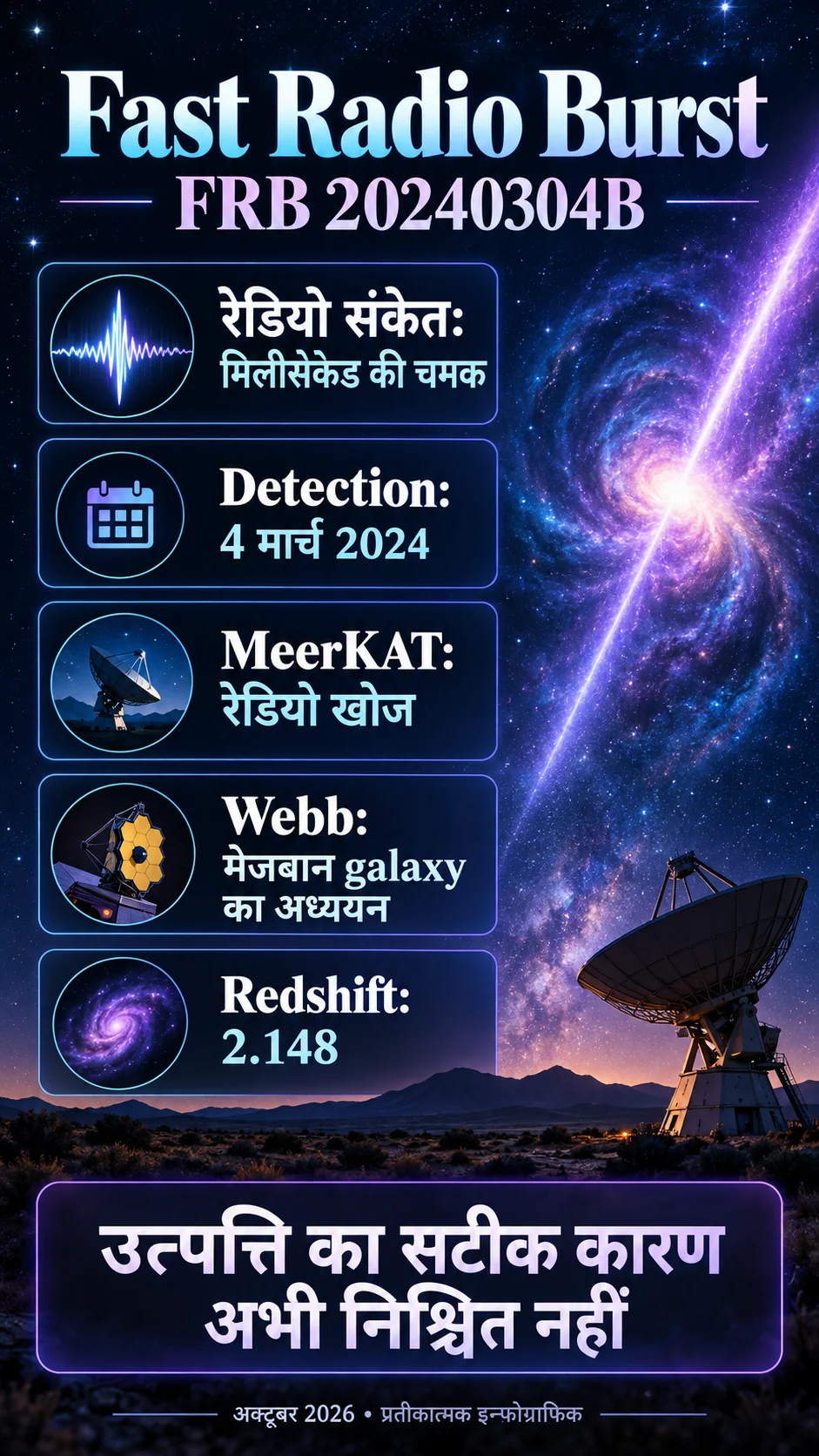
- Radio detection: 4 March 2024, using South Africa’s MeerKAT telescope.
- Webb’s role: identifying and studying the host galaxy.
- Host-galaxy redshift: 2.148.
- The associated cosmic epoch is about 3 billion years after the Big Bang.
- The exact physical mechanism generating the burst remains uncertain.
What did MeerKAT and Webb each do?
The Oxford release describes MeerTRAP’s detection and localisation using MeerKAT. The radio data suggested an extremely distant event. Follow-up observations of its host were then required.
The NASA account says Webb’s NIRCam detected the galaxy at the relevant position and NIRSpec measured its redshift. Saying that Webb caught the radio burst would merge different instruments’ roles. Results at different wavelengths were combined.
Position, galaxy identification and spectroscopy provide different pieces of evidence. Knowing where something happened and measuring the properties of the object at that location are distinct steps. A headline can compress this process, but separating the steps makes the discovery easier to understand.
Detection and publication timeline
| Date / तारीख | Update / घटना |
|---|---|
| 4 March 2024 | MeerKAT/MeerTRAP detected FRB 20240304B. |
| 8 October 2026 | Science online publication; NASA and Oxford announcements. |
| 13 October 2026 | Date on the University of Sydney news page. |
| 14 October 2026 | Sources checked for this explainer. |
What do redshift 2.148 and the long journey mean?
The NASA cosmological-redshift explainer describes light’s wavelength stretching as it travels through expanding space. Redshift is a measurement from the spectrum, not simply a label for a galaxy looking red in a picture.
The research abstract gives a host redshift of 2.148 ± 0.0013, associated with an epoch about three billion years after the Big Bang. Here, three billion years describes the universe’s age at that epoch. The journey lasting more than ten billion years answers a different question.
Do not automatically turn a travel time into the same numerical present-day distance. Space expanded during the journey. This article does not add an unverified current-distance estimate or convert between distance conventions. When reading a headline, check whether a number represents cosmic age, lookback time or a specified definition of distance.
“Most distant known” concerns the discoveries available to researchers. It does not establish that no more distant FRB can exist. New detections and host measurements can change such records; an observational limit is different from a limit imposed by nature.
Why the small, young galaxy matters for origin models
The Max Planck release describes a host far less massive than expected and actively forming stars. This matters because proposed origins must fit an event’s environment and timescale.
The ESA/Webb explanation points towards a young-magnetar scenario. A magnetar is a neutron star with an exceptionally strong magnetic field. Another proposed origin involves two neutron stars merging. The young host makes a scenario requiring a very long delay harder to explain.
This is a clue favouring a model, not a direct image of this burst’s engine. “Suggests”, “likely” and “confirmed” represent different levels of conclusion. Describing the study as a final explanation of every FRB would exceed the finding.
Learning from one event is also different from showing that all events share its cause. Further hosts and signals will help test where the models fit. No single mechanism is declared definitive for the whole class in this article.
How can FRBs reveal matter between galaxies?
The Caltech FRB explainer describes how intervening material disperses radio signals, separating the arrival of different frequencies. Measurements of this effect help investigate the distribution of ordinary matter, especially when combined with information about galaxies.
This provides a way to study space that looks empty. Ordinary matter and dark matter should not be treated as interchangeable terms. Learning about gas from a signal does not automatically solve the nature of dark matter.
Scientific interest extends beyond a distance record. The environment of the source and the effects encountered along the path are different questions. A useful account explains what those measurements teach; calling a signal mysterious does not itself supply evidence for an extraordinary claim.
ADVICE — reading a viral astronomy story
- Open the original institution release or research abstract.
- Separate detection date from publication date.
- Distinguish the radio detection from the infrared host observation.
- Do not turn a suggested explanation into a certain discovery.
- Check whether an image is an illustration or a real telescope observation.
Five frequently asked questions about the FRB
Which FRB is this report about? FRB 20240304B, whose host study was published in October 2026.
Was the radio signal first detected in October? The radio detection was on 4 March 2024. Publication and institutional announcements came separately.
Did Webb act as the radio detector? MeerKAT detected the radio burst; Webb studied its host in the infrared.
Does the finding confirm an alien message? The study and institutional conclusions presented here do not establish that. They examine natural-origin models.
Is the origin fully solved? The young host supplies a clue. The precise mechanism and a final explanation for all FRBs remain unresolved.
Research sources and related reading
Research abstract on PubMed · Science DOI: 10.1126/science.adz2675 · NASA Webb release · Sydney announcement · Oxford release · ESA/Webb explanation · Redshift explainer · FRBs and ordinary matter · Max Planck release. Checked on the evening of 14 October 2026.
यह Fast Radio Burst व्याख्या हिंदी में पढ़ें · More trending news: Apple HomeView
This science explainer uses the public research abstract and institutional releases. Images are conceptual, not observations or scale diagrams. Further research can change records and interpretations.