From school days to this day, whenever it’s time to speak or write English, the very first mental block is always ‘Tense’. Which verb to use, whether it should be Was or Had been—this exact confusion breaks all confidence. But once you understand the basic logic, it becomes as easy as a math formula.
What is Tense and Why is it Important in English?
When we talk in any language, two things are most essential: Action and Time. Tense is essentially that form of a verb which tells us when an event occurred, is occurring right now, or will occur in the future. Without the correct tense, your sentence remains incomplete and meaningless.
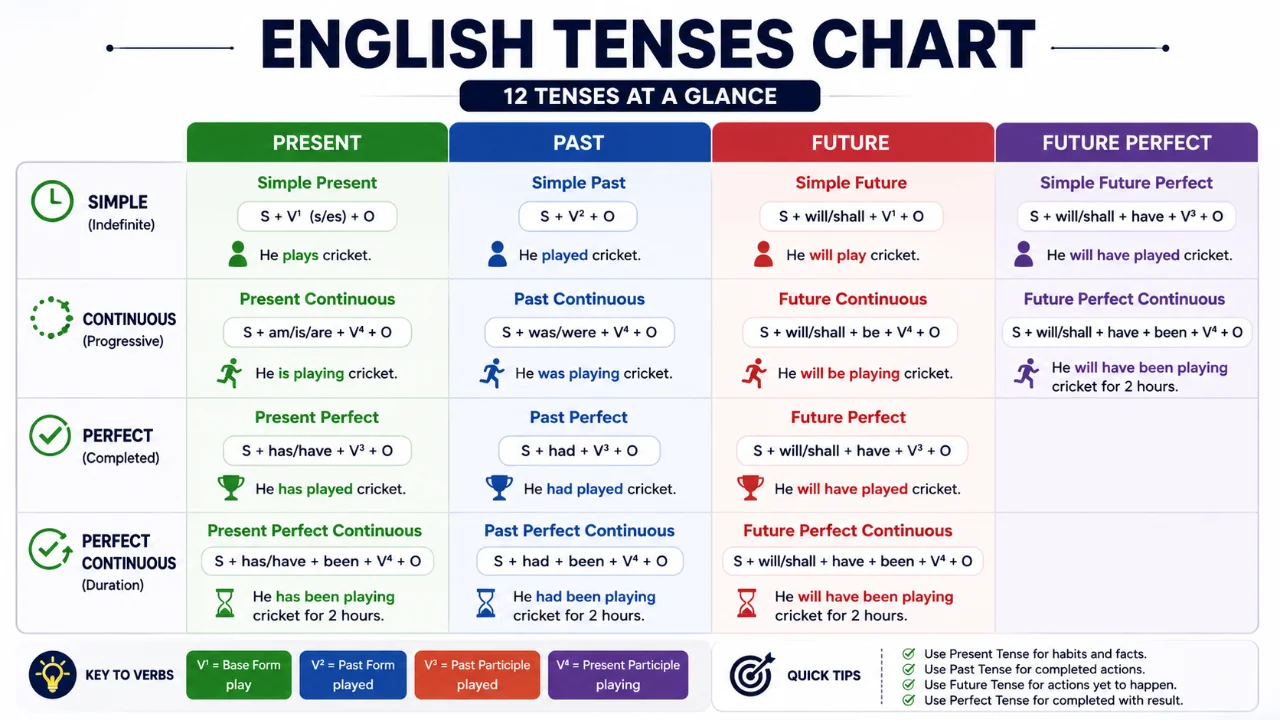
Most English learners know the meanings of words, but when it comes to stringing them together into a sentence, they get stuck. Understanding a proper tense chart in english grammar is essential because it brings clarity to your thoughts. If you say ‘I ate’ instead of ‘I eat’, the entire meaning of your statement changes.
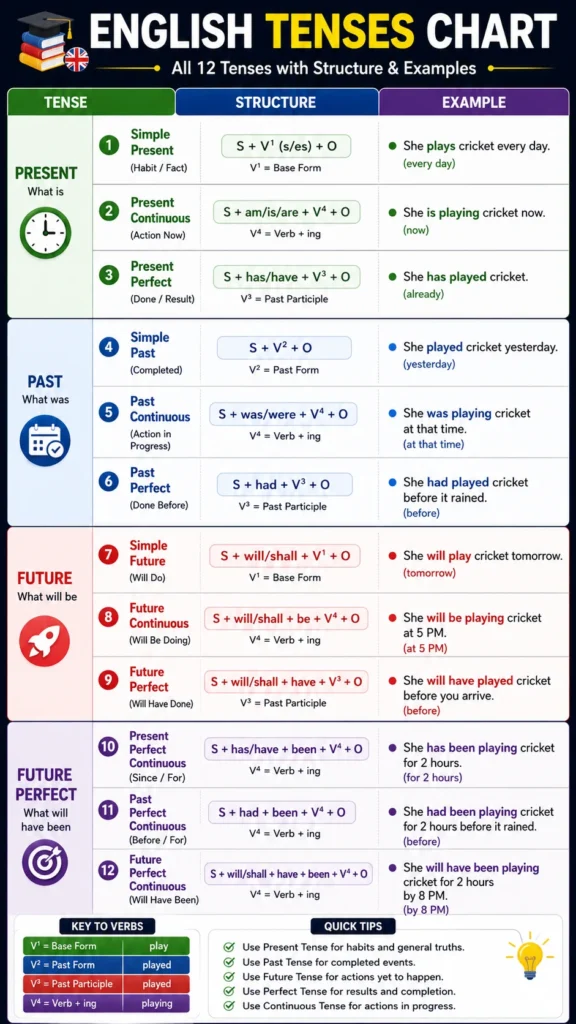
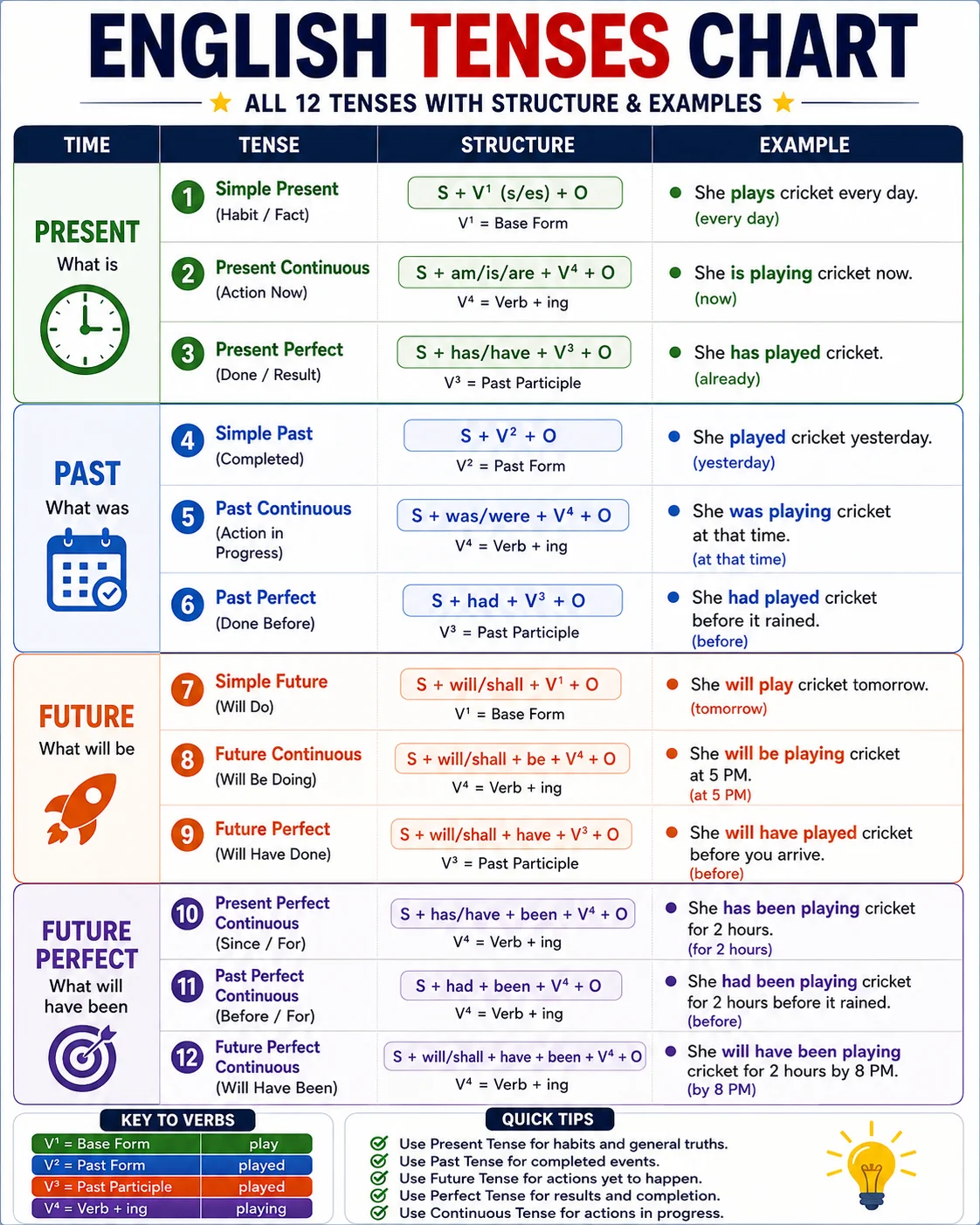
Time is broadly divided into three main parts: Present, Past, and Future. Based on the status of the action, each of these three tenses is further divided into four sub-types, making a total of 12 Tenses.
Master Tense Chart: Rules and Formulas for All 12 Tenses
The table below provides the basic formulas for all three main tenses and their four types. By looking at it carefully, you can understand which Helping Verb and Main Verb are used in which tense:
| Tense Type | Present | Past | Future |
|---|---|---|---|
| Simple / Indefinite | Sub + V1 (s/es) | Sub + V2 | Sub + will + V1 |
| Continuous | Sub + is/am/are + V1+ing | Sub + was/were + V1+ing | Sub + will be + V1+ing |
| Perfect | Sub + has/have + V3 | Sub + had + V3 | Sub + will have + V3 |
| Perf. Continuous | Sub + has/have been + V1+ing | Sub + had been + V1+ing | Sub + will have been + V1+ing |
Remembering this compact structure will make it clear to you that Continuous always uses the ‘ing’ form and Perfect always uses the Third Form of Verb (V3).
4 Forms of Present Tense: Identification, Rules, and Everyday Examples
Present Tense is used for things happening right now or those that are part of our daily routine. It is understood in four parts:
1. Present Indefinite (Simple Present): Shows a habit, universal truth, or routine action.
Structure: Subject + V1 (s/es) + Object.
Example: He plays cricket.
2. Present Continuous: An action ongoing at the time of speaking.
Structure: Subject + is/am/are + V1+ing + Object.
Example: She is reading a book.
3. Present Perfect: An action that has just been completed.
Structure: Subject + has/have + V3 + Object.
Example: I have finished my homework.
4. Present Perfect Continuous: An action started in the past and still ongoing.
Structure: Subject + has/have been + V1+ing + since/for + Time.
Example: They have been living here for two years.
4 Forms of Past Tense: Writing Past Events Correctly
Past Tense is used for events that finished in the past. Most mistakes here occur regarding verb forms.
1. Past Indefinite (Simple Past): Only uses the second form of verb (V2).
Structure: Subject + V2 + Object.
Example: We went to the market yesterday.
2. Past Continuous: An action was ongoing at a specific time in the past.
Structure: Subject + was/were + V1+ing + Object.
Example: He was driving a car.
3. Past Perfect: An action was completed before another event in the past.
Structure: Subject + had + V3 + Object.
Example: The train had left before we reached.
4. Past Perfect Continuous: An action was continuously ongoing from a specific point in the past.
Structure: Subject + had been + V1+ing + since/for + Time.
Example: She had been waiting since morning.
4 Forms of Future Tense: Structuring Future Plans and Possibilities
Future Tense is used to express activities happening in the upcoming time. In modern English, ‘will’ is commonly used with all subjects.
1. Future Indefinite (Simple Future): For a general action in the future.
Structure: Subject + will + V1 + Object.
Example: I will call you tomorrow.
2. Future Continuous: An action that will be continuously ongoing at a specific time in the future.
Structure: Subject + will be + V1+ing + Object.
Example: They will be travelling at this time.
3. Future Perfect: An action that will be completed by a specific time in the future.
Structure: Subject + will have + V3 + Object.
Example: She will have completed the project by Monday.
4. Future Perfect Continuous: An action that will continue continuously up to a specific point in the future.
Structure: Subject + will have been + V1+ing + for/from + Time.
Example: He will have been teaching for five years.
4 Common Mistakes While Learning Tenses and How to Avoid Them
It is often seen that even after memorizing rules, people make small mistakes while speaking or writing. Identifying these errors is crucial so that your English sounds natural:
- Using V2 with Did: The most common error is ‘I did not went’. The correct form is ‘I did not go’, because ‘Did’ is already in the past tense.
- Confusion between Since and For: Use ‘Since’ for a point in time (e.g., 2 PM, Monday, 2015) and ‘For’ for a duration of time (e.g., 2 hours, 5 days).
- Forgetting s/es with He/She: In Present Simple, adding s/es to the verb with Third Person Singular is mandatory (e.g., ‘He goes’, not ‘He go’).
- Incorrect Verb with Has/Have: Always use the Third Form (V3) in Perfect Tense; never use First or Second Form.
By practicing these basics, you can make your grammar accurate to a great extent.
A Practical Way to Remember Tenses Instead of Rote Learning
Parroting rules from books never brings fluency. The mind retains rules only when you connect them to real life. An easy method is to try speaking about your daily routine in all three tenses.
For example, wake up in the morning and think: ‘I wake up early’ (Present), think about yesterday: ‘I woke up early yesterday’ (Past), and what you will do tomorrow: ‘I will wake up early tomorrow’ (Future). When you use the same verb in different contexts, your brain starts picking the correct helping verbs without overthinking.
Make a habit of framing such short sentences for just 5 to 10 minutes daily. Keep the chart in front of your study table or save it on your phone so you can refer to it instantly when needed.
Vivek Bhai’s Advice
People often ask me, “Brother, we’ve been studying English grammar for years, but whenever we have to speak English in front of someone, why does our mind go completely blank?” The truth is that our entire education has relied on memorizing rules, whereas a language is learned by using it.
There is a simple rule of cognitive science called ‘spaced repetition’ and ‘active recall’. When you only look at a tense formula on paper, it goes into short-term memory. But when you create 5 new sentences of your own using that formula, it becomes part of your subconscious mind.
In today’s digital world, if you want to understand something quickly, record short audio notes or talk to yourself in front of the mirror. Unless you remove the fear of making mistakes from your heart, confidence won’t come. Speak wrong if needed, but definitely speak.
Look brother, it’s simple—tenses aren’t rocket science. It is just a framework that tags your statement with the right timeframe. Start framing small sentences with the help of this chart today, and you will feel the difference yourself in just a few weeks.
Frequently Asked Questions
How many Tenses are there in total in English Grammar?
There are primarily 3 main Tenses: Present, Past, and Future. Each has 4 sub-types (Simple, Continuous, Perfect, Perfect Continuous), making a total of 12 Tenses.
What is the difference between Present Perfect and Simple Past?
Simple Past describes a past action with no direct connection to the present (e.g., I ate food). Present Perfect describes an action that has just been completed and whose impact is still present (e.g., I have eaten food).
How to correctly use Since and For?
Since is used for a specific point in time or starting time (e.g., Since 1990, Since morning). For is used to show a total duration of time (e.g., For 2 hours, For 5 days).
What is the best way to learn Tenses quickly?
After understanding the formulas from the chart, create 10-15 sentences of your own based on daily activities in different tenses and practice them by speaking out loud.
Disclaimer: The information provided in this article is for general awareness only.