Focus: strategic autonomy India explained
Category: 85 News and Trending
What it Means in One Line
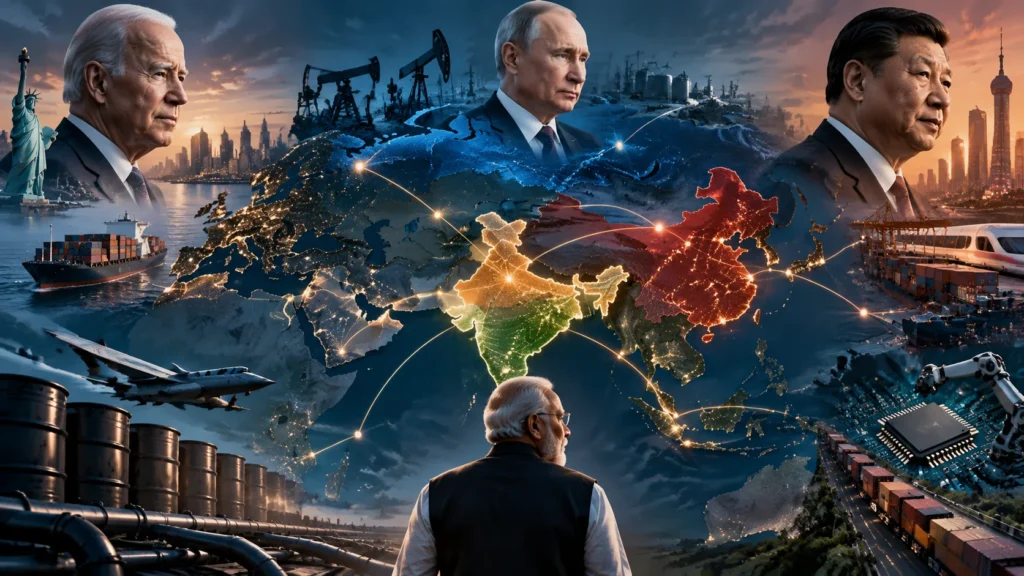
India’s strategic autonomy does not mean that India will refrain from making friends with any country or remain strictly “neutral” on every issue. Its real meaning is this: in major decisions, India keeps its options open based on its security, energy, technology, and trade needs—so that its policy doesn’t buckle under the pressure of any single power. Today, this effort appears tied to balancing between the US, Russia, and China, but on the map, its lines stretch across West Asia, Europe, the Indo-Pacific, and the Global South.
Reading it like a slogan leaves the story incomplete. It is better understood as a map and timeline: which dependency risk exists in which sector, what options India has, and how much time it will take to convert that option into actual capability.
First Understand the Map: Four Axes, Four Different Calculuses
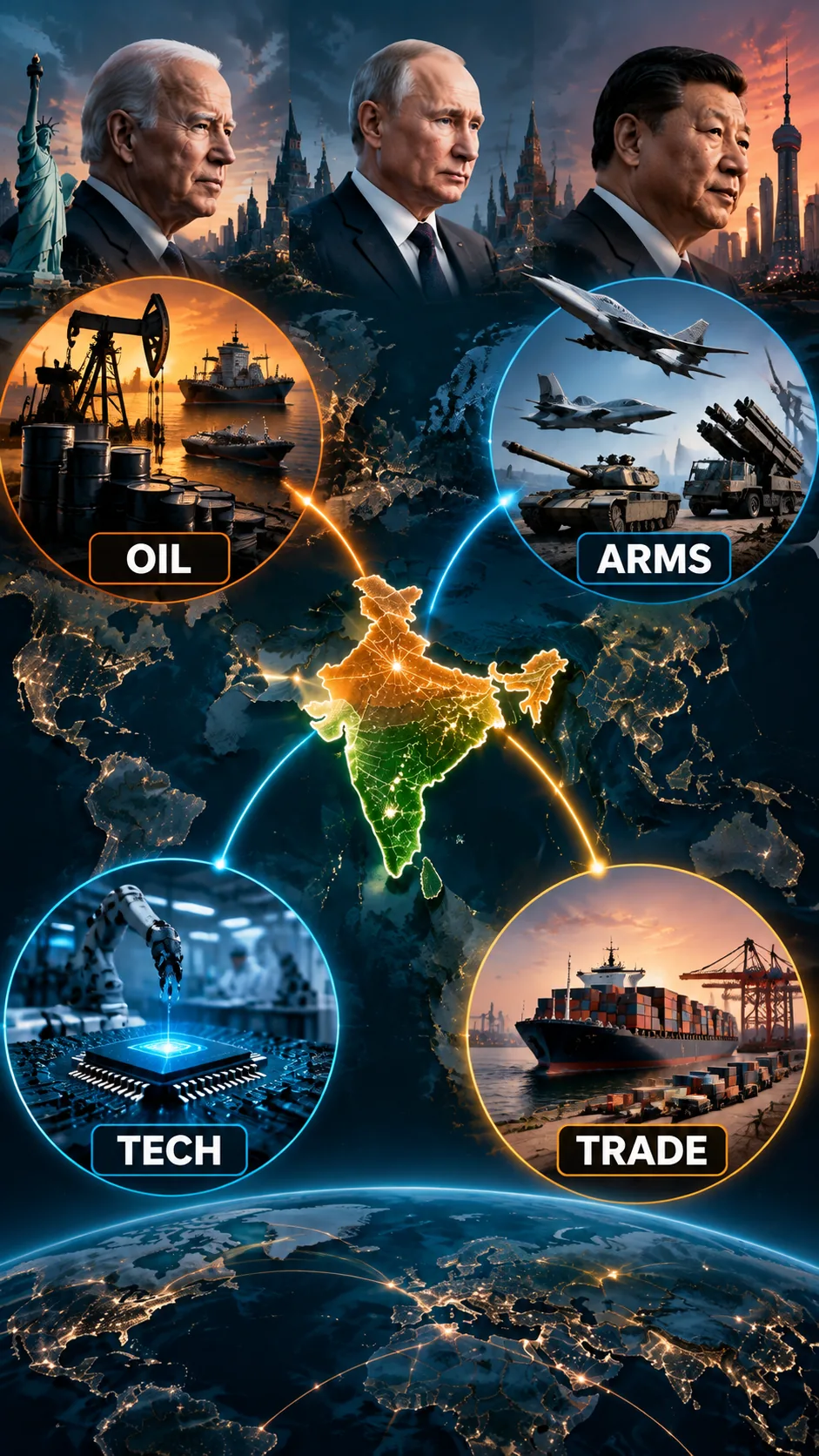
India’s balancing act rests on four main axes. It would be a mistake to view these axes as duplicates of one another. An oil relationship can change quickly, an arms relationship lasts for decades, technology involves standards and know-how, and trade involves both markets and supply chains.
1. Oil: The Maritime Map of Energy Security
India’s economy requires a continuous supply of energy to run. Domestic production, import sources, sea routes, refineries, and payment arrangements—all together define oil security. Therefore, India’s energy map is not just a Washington-Moscow-Beijing triangle. Gulf countries, Iran, Russia, shipping lanes, and global energy markets all feature in it.
Viewing crude purchases from Russia or business with West Asian suppliers purely through the lens of “which camp India belongs to” is wrong. India’s practical questions are: what is the available supply, price, transport risk, sanctions impact, and refinery compatibility? For this reason, reducing dependency on any single supplier is inherently a part of strategic autonomy.
However, cheap or available oil is not a free lunch. Western sanctions on Russia, shipping insurance, and evolving payment channels bring risks. Tension in the Gulf can affect maritime security. In case of a crisis at a chokepoint like Hormuz, route risk remains even with purchases spread across different suppliers. Therefore, oil autonomy does not mean declaring “self-reliance in oil,” but building a mix of sources, routes, storage, renewables, and efficiency.
China enters the map here in two ways: as a major energy consumer and as an important actor in manufacturing and clean-energy supply chains. India must both compete with China and prepare by understanding its supply-chain power in several global markets. In the oil axis, the importance of the US stems from sanctions, global markets, maritime presence, and alternative energy partnerships; Russia’s importance comes from supply and long-standing ties; the Gulf’s importance lies in proximity and capacity. This is the multi-vector policy.
2. Arms: Not Just Procurement, a Long-term Security Architecture
India’s defense ecosystem has a large legacy of Soviet/Russian-origin platforms and systems. Legacy networks for training, spare parts, maintenance, and ammunition are tied to this. Thus, abruptly severing ties with Russia could create operational risks. But heavy dependence on a single source also creates risks of supply disruption, technology access, and upgrades. This very tension drove diversification.
As defense cooperation with the United States grew, avenues opened for capabilities like exercises, maritime domain awareness, transport, and secure communications. India accepted certain interoperability and information-sharing frameworks through US defense agreements, but this does not mean NATO-like alliance membership. Relationships with French, Israeli, and other suppliers are also part of this broader diversification map.
The next step in arms autonomy is domestic design, production, maintenance, and export capability. Even if a platform is assembled in India, full autonomy is not achieved if the engine, seeker, chip, software, or critical spares come from outside. Therefore, defense indigenization must move beyond assembly to design authority, testing ecosystems, metallurgy, electronics, and dependable supply chains.
China is the most direct security challenge on this axis. The Himalayan border, maritime domain, and strategic infrastructure in the neighborhood create immediate questions of readiness and deterrence for India. For this reason, India expands exercises and maritime cooperation with the US, France, Japan, Australia, and other partners, while also maintaining legacy systems and diplomatic channels with Russia. This is not a contradiction, but different instruments for different risks.
3. Tech: The Triangle of Access, Standards, and Control
In technology, strategic autonomy does not mean disconnecting from the world. India needs advanced semiconductors, telecom equipment, aerospace systems, cyber tools, cloud infrastructure, AI compute, medical technologies, and clean-energy hardware. Building full domestic capacity in every sector immediately is not possible. The real question is: does India have options, skills, data governance, and fallbacks at the critical layer?
The US and its allies hold strong positions in many frontier technologies, research networks, and standards-setting institutions. Partnership with them can offer India capital, know-how, and trusted supply chains. However, the history of export controls, licensing, and technology denial shows that access is not always automatic. Strategic autonomy therefore demands domestic R&D and bargaining capacity alongside partnerships.
The technology relationship with Russia is visible in defense and nuclear energy. China is a major factor in manufacturing scale, electronics, batteries, solar components, and many industrial inputs. While recognizing the import risks associated with China, India must also realize that supply chains cannot be decoupled overnight. “De-risking” and “decoupling” are different things: the former works on weak links, critical dependencies, and alternate sourcing; the latter is a massive and expensive decision to sever the entire relationship.
Digital public infrastructure, open standards, and domestic engineering talent can enhance India’s bargaining power. But shutting down innovation in the name of data localization, cybersecurity, or self-reliance will not bring autonomy. A better goal is: control and resilience in sensitive systems, and open competition and global collaboration in non-critical areas.
4. Trade: Both Market and Leverage
India’s trade map spans the US, Europe, the Gulf, ASEAN, Russia, and neighboring countries. The US is a major market and technology-finance partner. Europe is an important region for standards, capital, and high-value trade. The Gulf is linked to investment, energy, and logistics. Russia is a useful partner in defense and certain commodities, but its trade basket and payment mechanisms have their own constraints. China is a large neighbor and manufacturing-linked trading partner, as well as a strategic competitor.
Trade autonomy does not mean exiting any single market. It means diversifying export destinations, making domestic firms competitive, building alternatives for critical imports, and gaining a voice in rule-making. India can advocate the language of a rules-based system at the WTO, but real autonomy will grow only when its producers can sustain themselves on quality, price, logistics, and scale.
In supply-chain diplomacy, friend-shoring, trusted partners, and resilient corridors are useful tools, but they can also create new dependencies. Importing from a “friendly” country does not mean supply risk has vanished. Checks on technology, shipping, insurance, currency, and political stability are all necessary. India’s goal should be to manage risk, not merely change the supplier’s label.
Timeline: From Non-Alignment to Flexible Partnerships
1947–1960s: Foundation of an Independent Foreign Policy
After independence, India shaped its foreign policy amidst colonial experiences, development needs, and the threat of wars. The idea of non-alignment was not passive neutrality. Its goal was to ensure newly independent nations did not become automatic extensions of any superpower bloc and could determine policy based on their national interests. In that era, economic development and sovereignty were twin strategic priorities.
1971: Security Crisis and Treaty with Moscow
During the 1971 Bangladesh Liberation War, the Indo-Soviet Treaty of Peace, Friendship and Cooperation showed that hard-security calculations are necessary alongside principles. Calling this a formal alliance in today’s sense would be inaccurate, but the episode illustrates that autonomy does not mean staying distant from partners, but creating policy space during a crisis. The US and China were close to Pakistan at the time; the regional map shaped New Delhi’s calculations.
Post-1991: Economic Opening and New Options
With the end of the Cold War, India embarked on economic reforms. Alongside the old Soviet ecosystem, the importance of Western capital, technology, and markets grew. The 1998 nuclear tests and subsequent diplomatic negotiations brought both technology restrictions and strategic dialogue to the fore. India asserted its nuclear doctrine and security concerns while continuing engagement rather than retreating into isolation.
2005–2008: Relationship Reset Through the Civil Nuclear Agreement
The US-India Civil Nuclear Initiative provided strategic direction to bilateral relations. Following the Nuclear Suppliers Group waiver in 2008, the doors to global civil nuclear commerce opened for India, despite not being a signatory to the Nuclear Non-Proliferation Treaty. This development taught the lesson that autonomy and partnership are not mutually exclusive: India could secure new institutional space while maintaining its stance.
2010s: Indo-Pacific, Quad, and Defense Diversification
In this decade, China’s economic and military rise, South China Sea tensions, and supply-chain concerns brought the Indo-Pacific to the center of the policy map. The revival of the Quad and US-India defense agreements expanded cooperation on maritime domain awareness and interoperability. At the same time, India maintained legacy defense ties with Russia, strategic cooperation with France, and active engagement with West Asia. Rather than calling this “joining a camp,” it should be understood as a portfolio approach.
2020: Border Crisis and the China Factor
The 2020 border crisis in Eastern Ladakh pushed the trust deficit with China to the top of security planning. Subsequent debates intensified over infrastructure, military preparedness, investment screening, telecom choices, and supply-chain resilience. Yet, being neighbors, the China factor cannot disappear from trade, climate, public health, and multilateral forums. Competition and selective engagement can coexist, but political trust remains difficult without border stability.
Post-2022: The Ukraine War and ‘Issue-Based Alignment’
The Russia-Ukraine war presented a tough balancing test for India. While continuing defense, tech, and Indo-Pacific cooperation with Western nations, India did not abandon its historic ties and energy interests with Russia. Official emphasis remained on dialogue, diplomacy, and national interest. Here, the practical meaning of strategic autonomy emerged: rather than identical voting patterns or rhetoric on every issue, distinct calculations were applied to different dossiers.
During this period, discussions expanded around the voice of the “Global South,” food and energy security, sanction spillovers, currencies, and payment systems. India must examine how any crisis impacts its households, industry, defense readiness, and immediate neighborhood.
Today’s Direction: Multi-Alignment, But Without Illusions
Today, India seeks to attract US and European technology and capital; manages defense, nuclear, and energy channels with Russia; handles border and strategic competition with China; and explores new economic links with the Gulf, ASEAN, Africa, and Latin America. Many analysts call this “multi-alignment.” This term is useful, but only if backed by domestic capacity. If policy relies solely on declarations without fallback options for critical inputs, autonomy will remain on paper.
How to Read the Map Like a Decision Tree
Ask five questions during any new crisis:
1. Exposure: Where is India’s actual dependence in this sector—source, route, software, spares, finance, or market?
2. Substitutability: How quickly can an alternative become available? An oil cargo and a fighter engine cannot be viewed on the same timeline.
3. Cost: What will be the impact on price, quality, jobs, and readiness when creating an alternative?
4. Leverage: Does the relationship with the existing partner give India bargaining power or create a one-way vulnerability?
5. Reversibility: Can today’s decision be altered tomorrow, or will it create a decades-long lock-in?
Through this framework, slogans fade and policy trade-offs become clear. For example, in defense, distancing from Russia may have strategic appeal, but transitioning the inventory and spares will take time. In tech, reducing Chinese dependency is justified, but interim imports and trusted sourcing are needed until domestic capacity matures. In trade, sanctions compliance may be necessary, but energy affordability and the continuity of payment channels must also be weighed.
Does Strategic Autonomy Mean ‘Friends with Everyone, Trust No One’?
No. Autonomy does not mean rejecting trust, but institutionalizing and diversifying it. A deep relationship with a partner does not mean accepting their view on every issue. Similarly, having multiple partners does not mean India can satisfy everyone equally. Strategic choices carry costs—sometimes speed, sometimes price, sometimes diplomatic criticism. Mature autonomy does not hide these costs; it clarifies which risk is being taken for what objective.
India’s credibility also stems from this. If it speaks of a rules-based order, it must explain principles through consistent reasoning rather than selective application. If it champions the Global South, it must work on practical solutions for finance, food, technology, and climate. And if it talks about self-reliance, it must place competition, research, and manufacturing quality above rhetoric.
Takeaway for the General Reader
Strategic autonomy is not a switch that the government can simply turn on. It is a stack of capabilities: a secure energy mix, a strong navy and logistics, reliable defense maintenance, domestic R&D, a skilled workforce, diversified exports, resilient finance, and diplomatic credibility to make decisions during crises. The US, Russia, and China influence different parts of this stack, but India’s final outcome depends on its own institutions and economic strength.
Therefore, a better question than “Which camp is India in?” is: On which issue does India have how many options, and what is the cost of those options? That is the real meaning of strategic autonomy.
FAQ: Five Direct Questions
1. Is strategic autonomy just a new name for non-alignment?
Not entirely. Non-alignment emerged in the context of Cold War bloc politics. In today’s world, India simultaneously maintains defense, technology, and trade partnerships with multiple countries. Strategic autonomy draws policy independence from that older idea but applies it in a new context of multi-alignment, supply-chain resilience, and domestic capability.
2. How can India be close to the US while maintaining ties with Russia?
Because the relationships are based on different needs. With Russia, India has legacy defense systems, nuclear cooperation, and diplomatic channels. With the US, it has technology, maritime cooperation, investment, and Indo-Pacific interests. India’s objective is not to copy any single partner’s foreign policy, but to build overlapping partnerships for its security and development needs. Still, trade-offs involving sanctions, interoperability, and trust must be managed in both relationships.
3. Would stopping trade with China constitute strategic autonomy?
Not necessarily. Critical dependencies and general trade must be analyzed separately. Risk reduction in border security and sensitive technology may be essential, but abruptly cutting off the entire trade relationship could severely impact industries, consumers, and supply chains. A better approach is sector-wise exposure assessment, alternate suppliers, domestic capacity building, and transparent security screening.
4. How can autonomy in oil purchases be increased?
By diversifying sources and routes, increasing strategic storage and refining flexibility, investing in renewables and efficiency, and understanding payment and shipping risks. Buying at a lower price from a single country isn’t autonomy; the ability to maintain supply during a crisis is autonomy. Gulf suppliers, Russia, domestic production, and the clean-energy transition must be viewed together on a unified map.
5. What should an average citizen look for in this debate?
Look beyond the headlines and ask: How will this decision impact energy prices, jobs, privacy, national security, exports, and long-term technology capability? Do not judge any partnership solely by a “pro-US” or “pro-Russia” label. Evaluate the source, timeline, fallback options, and accountability. That is informed citizenship.
Advice: Three Precautions While Reading the News
First, do not mistake a visit or joint statement for an alliance; look at actual agreements, funding, delivery, and implementation. Second, do not judge an arms purchase by headline price alone; evaluate lifecycle support, local maintenance, and technology rights. Third, do not confuse self-reliance with isolation. India’s strength lies in converting trusted partnerships into domestic capabilities—capabilities that provide decision-making options in the next crisis.
Conclusion: The real test of India’s strategic autonomy is not about pleasing the US, Russia, or China. The test is whether India understands its dependencies across the distinct maps of oil, arms, tech, and trade to build choices. This balance is not a speech slogan, but continuous statecraft.
Disclaimer: Geopolitical analysis is for educational purposes. Verify official policy/data from primary sources.