Budget 2026 has introduced crucial updates to personal finance in India, creating fresh discussions among salaried professionals, freelancers, and small business owners. With the government declaring the New Tax Regime as the default tax filing mechanism, taxpayers across the country are eager to understand how the updated income tax slabs 2026-27 will impact their net take-home pay and overall financial planning.
Confusion frequently arises when evaluating social media claims regarding tax-free income thresholds. While some sources claim complete tax exemption up to ₹7 lakh, others mention ₹12 lakh or higher limits. Understanding how progressive tax slabs work alongside standard deductions and Section 87A rebates is essential to avoid costly filing errors and optimize your personal tax outgo.
In this comprehensive guide, we unpack the official income tax slabs 2026-27 under the New Tax Regime, compare them with the Old Regime, examine the revised rent TDS rules, and provide step-by-step tax calculations across various income brackets.
1. New Income Tax Slabs 2026-27 — Revised Rates and Structure
Under the New Tax Regime for FY 2026-27 (Assessment Year 2027-28), the tax structure is divided into multi-tier slabs. The New Regime operates on a progressive block system, meaning different portions of your taxable income are taxed at gradually increasing rates, rather than applying a single flat rate to your total income.
For instance, if your total taxable income is ₹12 lakh, the tax is computed progressively across each slab block rather than charging 15% on the full amount. Here is the official breakdown of the income tax slabs 2026-27 under the New Tax Regime:
| Income Slab (₹) | Tax Rate | Maximum Tax in Slab (₹) |
|---|---|---|
| 0 – 3,00,000 | 0% (Nil) | ₹0 |
| 3,00,001 – 7,00,000 | 5% | ₹20,000 |
| 7,00,001 – 10,00,000 | 10% | ₹30,000 |
| 10,00,001 – 12,00,000 | 15% | ₹30,000 |
| 12,00,001 – 15,00,000 | 20% | ₹60,000 |
| Above 15,00,000 | 30% | — |
This structure provides significant relief to middle-income earners. Taxpayers earning up to ₹10 lakh experience lower effective tax liability compared to older historical structures, boosting monthly liquidity for families across India.
2. Is Income Up to ₹7 Lakh Really Tax-Free? Section 87A Explained
Yes, income up to ₹7 lakh incurs zero net tax under the New Regime, but it is important to understand the exact technical mechanism. Tax technically accrues in the ₹3,00,001 to ₹7,00,000 bracket at 5%, totaling ₹20,000. However, the Income Tax Department grants a full tax rebate under Section 87A, effectively bringing the tax payable down to ₹0.
Key details to keep in mind regarding the Section 87A rebate:
- Strict Threshold: The rebate is available only if your total taxable income does not exceed ₹7,00,000.
- Standard Deduction Advantage: Salaried individuals and pensioners receive an enhanced Standard Deduction of ₹75,000 under the New Tax Regime.
- Effective Tax-Free Salary: Because the ₹75,000 Standard Deduction is subtracted first, a salaried individual earning a gross salary of up to ₹7,75,000 ends up with a taxable income of ₹7,00,000, paying zero income tax.
Taxpayers whose taxable income exceeds ₹7,00,000 by even a tiny margin lose the Section 87A rebate, making strategic income planning vital.
FACT BOX: Key Tax Changes in Budget 2026
- Default Regime: New Tax Regime is the default selection for FY 2026-27 filing.
- Basic Exemption: Income up to ₹3,00,000 is fully exempt from tax.
- Enhanced Standard Deduction: Salaried employees get ₹75,000 standard deduction under the New Regime.
- Effective Zero Tax Limit: Gross salary up to ₹7,75,000 results in zero tax post standard deduction and Sec 87A rebate.
- Rent TDS Threshold: Raised to ₹6,00,000 per year (₹50,000 per month).
- Employer NPS Benefit: Employer contribution to NPS under Section 80CCD(2) remains exempt in the New Regime.
- Annual Switch Option: Salaried employees can choose between Old and New Regime every financial year.
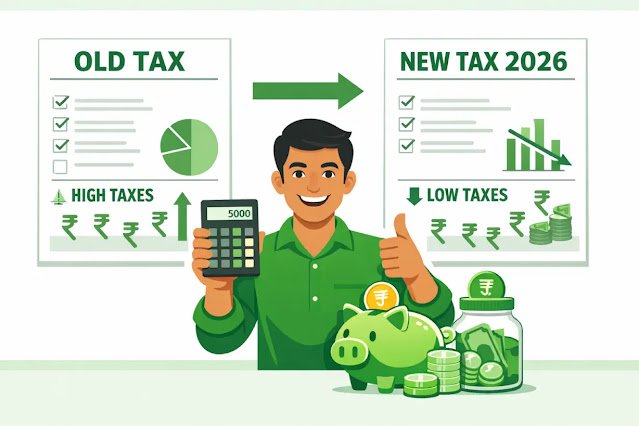
3. Old vs New Tax Regime 2026-27 — Which One Should You Choose?
Choosing between the Old Tax Regime and the New Tax Regime depends on your active financial commitments, such as home loans, insurance premiums, and tax-saving investments.
| Factor / Deduction | Old Tax Regime | New Tax Regime 2026-27 |
|---|---|---|
| Standard Deduction | ₹50,000 | ₹75,000 |
| Section 80C (PPF, ELSS, LIC) | Allowed up to ₹1.5 Lakh | Not Allowed |
| HRA Exemption | Allowed | Not Allowed |
| Home Loan Interest (Sec 24) | Allowed up to ₹2 Lakh | Not Allowed (Self-occupied) |
| Employer NPS (Sec 80CCD(2)) | Allowed | Allowed |
| Tax Rates | Higher (10% – 30%) | Lower Slabs (5% – 30%) |
| Filing Complexity | Requires Proofs & Receipts | Simple & Paperless |
Rule of Thumb: If your total eligible deductions under Old Regime (80C, HRA, Section 24 Home Loan Interest, 80D) exceed ₹3,75,000, the Old Tax Regime may yield lower tax. If your total deductions are below this mark, the New Tax Regime generally offers greater tax savings and lower compliance overhead.
4. Real Tax Calculations Across Different Salary Levels
To understand how the income tax slabs 2026-27 work in practice, review the tax calculations for various gross salary levels under the New Tax Regime (accounting for the ₹75,000 Standard Deduction and 4% Health & Education Cess):
| Gross Annual Salary | Taxable Income (After ₹75k SD) | Base Tax Computed | Cess @ 4% | Total Tax Liability |
|---|---|---|---|---|
| ₹7,75,000 | ₹7,00,000 | ₹0 (Sec 87A Rebate) | ₹0 | ₹0 |
| ₹10,00,000 | ₹9,25,000 | ₹42,500 | ₹1,700 | ₹44,200 |
| ₹12,00,000 | ₹11,25,000 | ₹60,000 | ₹2,400 | ₹62,400 |
| ₹15,00,000 | ₹14,25,000 | ₹1,35,000 | ₹5,400 | ₹1,40,400 |
| ₹20,00,000 | ₹19,25,000 | ₹2,85,000 | ₹11,400 | ₹2,96,400 |
As demonstrated, an individual earning ₹10 lakh pays an effective tax rate of just ~4.42%, while a ₹12 lakh earner pays ~5.20%. Beyond ₹15 lakh, tax liabilities scale up, making structured retirement and financial planning essential.
5. Rent TDS Limit Increased to ₹6 Lakh — Relief for Tenants and Landlords
Budget 2026 brought major administrative compliance relief for urban renters. Previously, tenants paying rent over ₹20,000 per month (₹2.4 lakh annually) were required to deduct 2% to 5% TDS under Section 194-IB and submit Form 26QC to the Income Tax Department.
The annual threshold for Rent TDS has been increased to ₹6,00,000 per year (₹50,000 per month). Tenants paying monthly house rent up to ₹50,000 are no longer required to deduct TDS or file compliance forms, significantly reducing paperwork for renters across major Indian cities.
6. Wealth Building, CIBIL Score, and Annual ITR Filing
While the New Tax Regime removes mandatory investment obligations under 80C, tax planning should remain closely aligned with long-term wealth creation. Consistently filing your Income Tax Return (ITR)—even when your tax liability is zero—serves multiple crucial purposes:
- Financial Credibility: Banks and non-banking financial companies (NBFCs) evaluate 3 years of ITR filings when approving home loans, personal loans, or credit cards.
- CIBIL Score & Credit Health: Timely loan repayments combined with verifiable income documentation strengthen your credit profile and improve CIBIL score tracking.
- Global Mobility: Official ITR acknowledgment forms serve as mandatory income verification documents for international visa applications.
💡 Vivek Bhai ki Advice: Smart Tax & Financial Strategy for FY 2026-27
The New Tax Regime simplifies tax filing, but do not let the absence of forced investment requirements make you negligent about building wealth. In the past, Section 80C compelled people to invest in ELSS mutual funds, PPF, or life insurance. With the New Regime becoming default, many taxpayers make the mistake of stopping investments altogether simply because immediate tax deductions are not available.
Here is my practical strategy for FY 2026-27:
- Avoid the ₹7 Lakh Trap: If your gross salary sits around ₹7.8 lakh to ₹8 lakh, a minor bonus or pay bump can push taxable income above ₹7 lakh, eliminating your Section 87A rebate and creating a tax bill exceeding ₹20,000. Use employer NPS contributions under Section 80CCD(2) to keep taxable income safely below the threshold.
- Uncouple Investments from Tax Savings: Build wealth intentionally through monthly equity mutual fund SIPs, independent of tax deduction requirements.
- Maintain an Emergency Fund: Ensure 6 months of living expenses reside in liquid fixed deposits or high-yield savings accounts before allocating capital to volatile assets.
- File Your ITR Every Year: Regardless of whether your final tax payable is zero, annual ITR filing establishes clean financial documentation for future loans and visas.
FAQ
Q1. How is income tax calculated for FY 2026-27 under the New Regime?
To calculate tax under the New Regime, start with your gross income and subtract the ₹75,000 Standard Deduction (if salaried or a pensioner). Divide the remaining taxable income into official slab brackets (0-3L at 0%, 3-7L at 5%, 7-10L at 10%, 10-12L at 15%, 12-15L at 20%, above 15L at 30%). Calculate tax for each segment, sum them up, add 4% Health & Education Cess, and apply the Section 87A rebate if taxable income is ₹7,00,000 or below. You can use an online Income Tax Calculator or Calculator Hub tool for precise verification.
Q2. Which deductions are allowed under the New Tax Regime 2026-27?
The New Tax Regime permits limited exemptions, including the enhanced Standard Deduction of ₹75,000 for salaried employees and pensioners, employer contribution to NPS under Section 80CCD(2), family pension deductions, and transport allowances for specially-abled individuals. Deductions like Section 80C, Section 80D, HRA, and self-occupied home loan interest under Section 24 are excluded.
Q3. How much tax is payable on a ₹12 Lakh salary in FY 2026-27?
On a gross salary of ₹12,00,000, deducting the ₹75,000 Standard Deduction leaves a taxable income of ₹11,25,000. Base tax across slabs totals ₹60,000 (₹0 for 0-3L + ₹20,000 for 3-7L + ₹30,000 for 7-10L + ₹10,000 for 10-11.25L). Adding 4% Health & Education Cess (₹2,400) results in a total tax liability of ₹62,400.
Q4. Is the Old Regime better than the New Regime for a ₹15 Lakh income?
For a ₹15,00,000 gross income, tax under the New Regime post standard deduction is approximately ₹1,40,400. The Old Regime becomes more beneficial only if you can claim total deductions exceeding ₹3,75,000 across Section 80C (₹1.5L), Section 24 Home Loan Interest (₹2L), HRA, and Section 80D health insurance.
Q5. Can salaried employees switch between Old and New Regimes every year?
Yes, salaried employees without business or professional income have the flexibility to switch between the Old and New Tax Regimes every financial year at the time of filing their Income Tax Return (ITR). However, individuals with business or professional income can switch out of the New Regime only once in their lifetime.
Disclaimer: This article is for informational and educational purposes only and does not constitute formal tax, legal, or financial advice. Tax laws, slab rates, and notifications are subject to change by the Central Board of Direct Taxes (CBDT) and Ministry of Finance. Always verify official notifications on the official Income Tax Department portal or consult a qualified Chartered Accountant (CA) before filing returns.