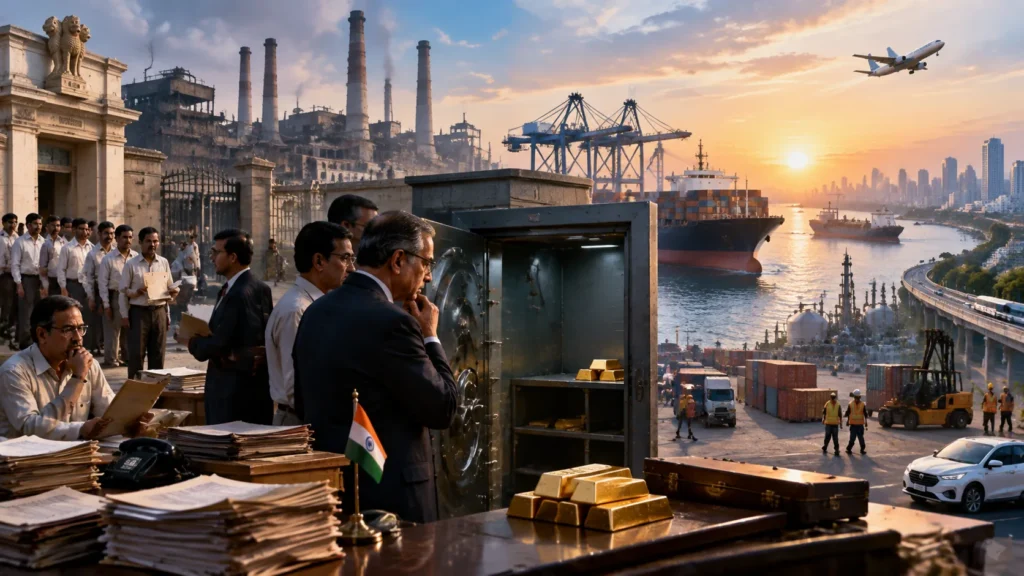
1991 is often turned into a poster: doors were opened, the License Raj was broken, and India started running. The poster is important, but it is not the whole story. In that year, the country’s foreign exchange buffer to pay for import bills became extremely thin. The government had to take emergency decisions, and amid those decisions, a new economic direction emerged. Therefore, understanding 1991 is not just about saying “growth came from liberalisation”. It is also a story of a forex crisis, the exhaustion of the old control system, political bargaining, and unfinished institutional work.
The focus of this article is: 1991 economic reforms explained — without slogans. What changed, what did not, who benefited, who bore the burden of adjustment, and why work remained stuck in sectors like labour, agriculture, and justice.
Crisis: why the foreign exchange door started closing
Understand the balance of payments like a household’s monthly budget. If expenses exceed income in a house, savings are exhausted, and lenders demand trust, routine bills start getting stalled. For a country, foreign exchange is that wallet through which bills for crude oil, fertiliser, machinery, inputs for medicines, and other imports are settled.
In the 1980s, India gave more space to some sectors compared to earlier times. Industrial growth and imports both increased, but fiscal pressure also kept accumulating. Amid public spending, external borrowing, and dependency on oil imports, strain built up on the current account. The Gulf crisis further increased oil prices and global uncertainty. After 1989, coalition politics made long-term decisions difficult; a minority government had to keep track of support at every step.
In 1990–91, the problem was not just that the dollar became expensive. If foreign exchange reserves are low and the time for import payment arrives, questions arise about the country’s creditworthiness. The rollover of non-resident deposits and commercial borrowing also depends on confidence. That is why the crisis was not a one-day accident; it was the simultaneous unfolding of several years of imbalances.
FACT: In standard public accounts, the peak crisis of 1991 is often described as foreign-exchange reserves being so low that the import cover remained for only a few weeks; many accounts give a rough band of “about two to three weeks”. An exact day-to-day number is not being claimed here. The point is that no policy-as-usual buffer was left.
In an emergency, pledging gold reserves, negotiating for external assistance, and adjusting the exchange value of the rupee had to be done. Without this background, calling the July 1991 Budget and the New Industrial Policy purely an ideology is an incomplete reading. It was a necessity, but amid necessity, there was also a policy choice: whether to manage the crisis with a temporary patch or to change the rules.
License Raj: permit was not just paperwork, it was a power network
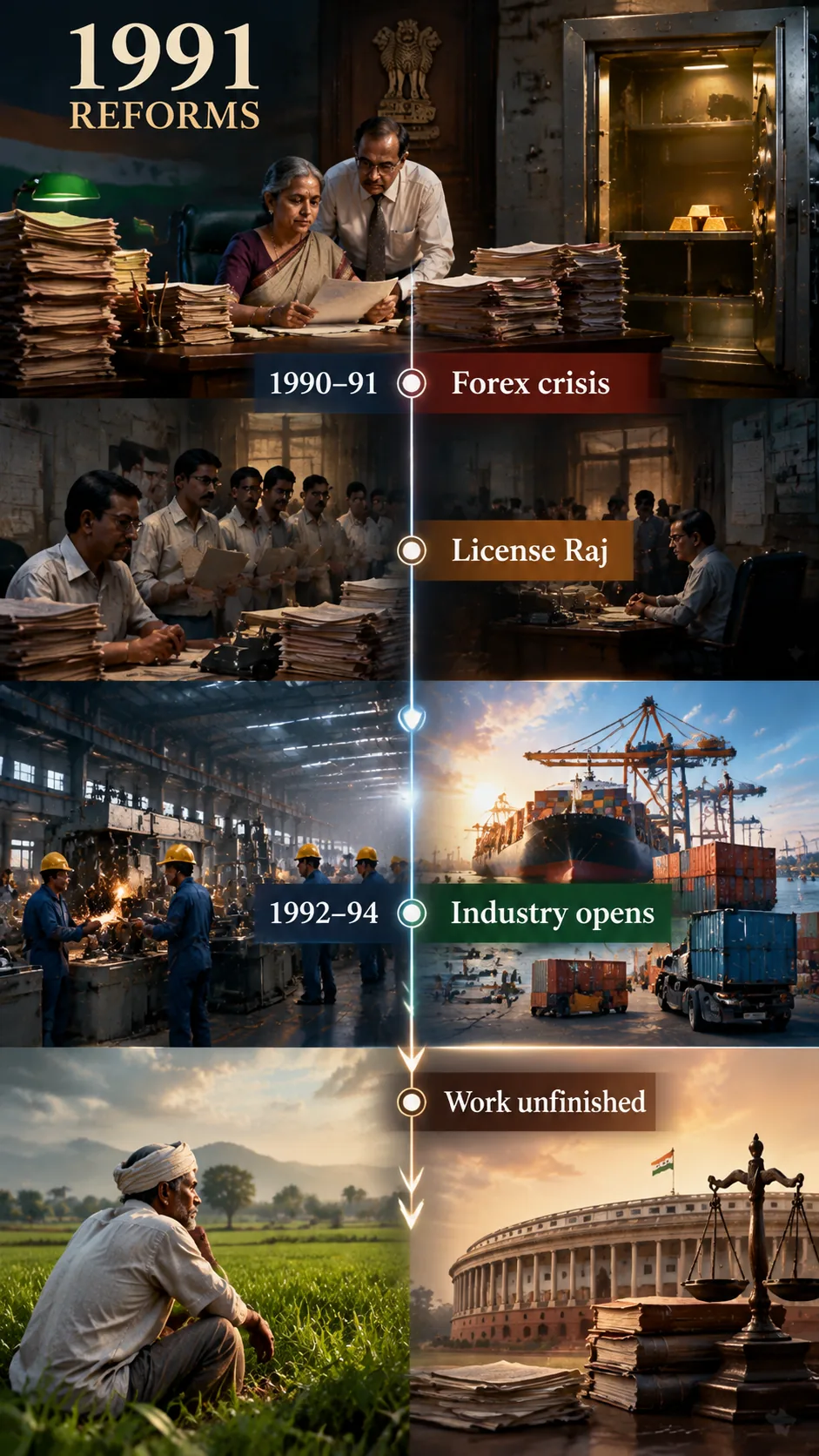
Before reform, industrial policy often meant separate permissions for capacity, product, location, technology, and imports. This system was popularly called the License Raj. Every license was not proof of corruption; some controls were created for strategic self-reliance, scarce foreign exchange, and regional balance. But over time, the scope for discretion kept growing.
Before setting up a factory, an entrepreneur faced gatekeepers for permission, approval for expansion, clearance for importing machinery, and separate approvals for foreign collaboration. File delays were an economic cost. A firm that already understood the system could gain an advantage; a new firm, a small entrepreneur, and state-level businesses found entry difficult. With reduced competition, quality and consumer choice were also impacted.
This does not mean that before 1991 there was no private enterprise in India at all. Tata, Birla, public-sector companies, small industries, and regional manufacturers were all functioning. But their decisions had to pass through a dense web of rules and permissions. “The size of the government” and “the government’s hand in every business decision” are not the same thing, but before 1991, the overlap between both was high.
The July 1991 Industrial Policy abolished or relaxed industrial licensing in many industries, except strategic or sensitive areas. Exclusive areas reserved for the public sector were also re-examined. A direction was set to change the constraints previously imposed on large firms through the MRTP framework. Doors were opened to some extent for foreign technology and investment. This was not a switch, but a process of gradually dismantling the architecture of permissions.
There was also a trade-off. Protection gave some firms breathing space, but competition exposed their inefficiency. Consumers could get variety and quality, but the burden of adjustment fell on workers of weak firms. Opening up the market does not automatically create social security. Subsequent reforms did not fully fill this gap.
The 1991 package: liberalisation, stabilisation, and structural change
1991 is packaged into three labels—liberalisation, privatisation, globalisation. It is useful shorthand, but one should not mix three distinct layers within it.
Stabilisation‘s immediate job was to manage external payments, bring inflationary pressure under control, and restore international confidence. Exchange rate adjustment, fiscal correction, monetary discipline, and external financing were part of this layer. The short-term effect of stabilisation can be uncomfortable: imports become expensive, pressure falls on demand, and the government has to make tough spending decisions.
Liberalisation meant reducing controls—changes in industrial licensing, import restrictions, administered prices, and parts of financial-sector rules. Tariff reduction was not completed in a single day. The import policy was changed in a phased manner. Along with allowing competition, the need for regulatory institutions also grew.
Privatisation should also be understood precisely. After 1991, public-sector disinvestment took place and private participation gained space in certain areas, but selling off the entire public sector was not the literal meaning of the package. The state’s role was to be re-negotiated among three functions: owner, regulator, provider, and welfare guarantor.
Globalisation meant greater integration with the world economy: opening channels for trade, capital, technology, and services. This brought both export opportunities and imported inputs. Along with this came the risk of global price shocks, capital-flow volatility, and foreign competition.
FACT CHECK: Calling 1991 a “switch-on moment” driven by a single law or a single leader is a flawed simplification. Emergency stabilisation and the July 1991 policy changes set the direction; sectoral reforms in tariffs, exchange controls, banking, tax, capital markets, and other sectors continued in subsequent phases. 1991 was the beginning, not the finish line.
Timeline: from crisis to reform direction
| Period | What happened | What it meant |
|---|---|---|
| 1980s | Some channels for industry and imports were opened earlier; fiscal and external pressures also built up | Vulnerabilities developed alongside growth |
| Post-1985 | Experiments with limited relaxation in technology and industrial policy | Demand for reform emerged from within the system |
| 1989 | Coalition era and political uncertainty | Long-horizon decisions became difficult |
| 1990–91 | Gulf crisis, oil shock, and external-payment stress | Sharp pressure on the foreign exchange buffer |
| Early 1991 | Emergency external support, gold pledge, and similar steps | Crisis moved beyond ordinary budget debate |
| June 1991 | P. V. Narasimha Rao’s government; Manmohan Singh as Finance Minister | Crisis management backed by a political mandate |
| July 1991 | Rupee exchange-rate adjustment and New Industrial Policy/Budget | Structural direction combined with stabilisation |
| 1992–94 | Next steps in trade, capital market, banking, and exchange regime | Reform became an ongoing process |
| Subsequent decades | Expansion of telecom, services, private investment, and state-level competition | Gains remained uneven and geographically varied |
The lesson of the timeline is that rather than saying “everything changed in 1991”, a more accurate statement is: in 1991, the anchor of the policy regime changed, and implementation continued for many years.
Who benefited, who had to adjust
The effect of reforms varied by household, firm, sector, and region. Export-oriented firms, technology-intensive companies, and skilled workers found new opportunities. Services—software, telecom, finance, logistics—capitalised on global connections. Consumers gained exposure to imported products, brand variety, and quality competition.
However, not every firm was competitive. Protected firms had to undertake product redesign, cost-cutting, and capital investment. Some workers in the organised sector saw risks of job insecurity, restructuring, or voluntary retirement. Informal workers had to face market swings without a formal safety net. Therefore, both slogans—”everyone won from reforms” and “everyone lost from reforms”—oversimplify reality.
The regional dimension is also important. Where ports, power, roads, skilled labour, and urban markets existed, attracting private investment was comparatively easier. Districts with poor infrastructure, weak credit access, and low state capacity did not get the same momentum. The Centre changed the rules, but implementation depended on states and local agencies.
What remained incomplete: the knot of labour reform
After 1991, the pace of changes in product-market rules was faster than in labour-market institutions. The debate on labour laws gets stuck between two extremes: give employers the freedom to hire and fire, or do not touch worker protection at all. Ground reality is more complex than both.
If a factory needs to scale up, the employer requires predictable rules. A worker needs notice upon termination, dues, a safe workplace, collective bargaining, and social security. In many places, India allowed the complexity of formal compliance and the insecurity of informal employment to co-exist. The result: several firms remained at small capacity, subcontracting grew, and workers were employed without permanent benefits.
FACT: The real test of labour reform is not just making rules “flexible”; it is also making registration, inspection, dispute resolution, skill training, and portable social-security access predictable. If flexibility is not accompanied by protection, reskilling, and timely justice, the risk of adjustment shifts to the worker.
The role of states here is very large. Labour administration, industrial relations, and the quality of local enforcement vary from state to state. Therefore, a ground outcome does not happen automatically from a national reform text.
Agriculture: markets opened, but who manages the farmer’s risk?
The centre of the 1991 reform package was industry and the macroeconomy; agriculture did not receive market-institution redesign of similar depth. For a farmer, output price alone does not matter. Input costs, irrigation, storage, transport, mandi access, crop insurance, land records, and timely credit are all part of one chain.
Trade and price reforms can offer export opportunities to some producers, but risks of global price falls, weather shocks, or input-price rises also follow. Small and marginal farmers may lack storage, have low bargaining power, and face tight cash flows. In such a scenario, “market freedom” is meaningful only when there are multiple buyers, transparent weighing, reliable payment, and local infrastructure.
Agricultural reforms are also tied to Centre–State subject boundaries. States play a strong role in APMC-type market arrangements, land leasing, irrigation, electricity, and rural roads. The Delhi version of a policy and a village-level transaction are not identical. Labeling a subsidy merely as a “distortion” is also incomplete; it can serve a livelihood insurance function. A better question for reform is: how to make support leak-proof and productive without exposing the farmer to sudden risks?
Justice, land, and contracts: the silent bottleneck of reform
Even if a business gets a license, work proceeds only when land titles are clear, contracts are enforced, electricity connections arrive on time, and dispute adjudication is predictable. Delays in courts, adjournments, and enforcement costs can deter private investment. For a small business, a contract dispute hanging unresolved for years freezes capital.
1991 challenged industrial control, but an institutional overhaul of justice delivery did not occur at that pace. Digitising land records is not a complete solution to title disputes; surveys, mutation, local administration, and an appeal chain are also required. The capacity of police, prosecution, and lower courts is not the glamorous part of economic reform, but it builds trust.
FACT: Measuring economic reform solely through tax rates, tariffs, or foreign investment approvals is incomplete. Transaction costs—permits, power, land, logistics, contracts, and court delays—are also part of productivity. Where state capacity is weak, the benefits of an “open market” can remain uneven.
Centre–State politics: one reform, different Indias
Industrial licensing was handled in the corridors of the Centre, so the signal from the New Industrial Policy was national. However, states played a direct role in the implementation of mandis, land use, local policing, schools, skills, transport, and electricity distribution. That is why saying “the whole of India opened up in 1991” is a Delhi-centric statement.
The Rao government presented the package in the language of crisis management rather than as an ideological victory. This created space between the coalition and the opposition. Subsequent governments continued, paused, or renamed reforms according to their politics. Federal finance was also important: lower tariffs placed pressure on some of the Centre’s traditional revenue streams, and states had to engage in separate bargaining for transfers, grants, and investment.
Reform becomes sustainable when state-level capacity, municipal governance, and local accountability improve. Factory gates, mandi yards, or courtrooms do not change by announcement alone.
What this means for today
There is no need to make 1991 into a savior or a villain. It addressed a real crisis and removed some costly layers of control. It opened doors to competition, technology, and global integration. But it did not magically solve inequality, informal work, farm risk, land conflicts, or court delays.
Today, when someone speaks of “second-generation reforms”, the question to ask is: flexibility for whom, security for whom, implementation in which state, and who pays the bill for the transition? Deregulation and improving regulation are two different things. Open markets require competition policy, labour protection, social insurance, and swift justice.
Advice
A practical way to understand 1991 is to create three columns: what opened, what became expensive, what remained pending. In the first column, list licensing reductions, trade, and technology access. In the second, list competition, job transition, imported price shocks, and regional inequality. In the third, list labour security, farm markets, land records, and courts.
For a student or job-seeker, the lesson is to study institutions rather than headlines. “Liberalisation” does not just mean private companies; it is a combination of skills, productivity, infrastructure, and rules. If you are starting a business, even after fewer licenses, you will need to understand tax, labour, local permits, contracts, and compliance calendars. For a farmer, upon hearing “market open”, examine the buyer count, payment turnaround time, storage, transport, and price-risk calculations.
When judging policy, do not stop at a story of one winner and one loser. Look at consumer prices, worker income, firm productivity, fiscal costs, and environmental impact together. If you find exact percentages or claims that “1991 changed everything” in a viral post, ask for the source and the year. Keep widely reported facts and political opinions separate.
💡 Callout: The best question regarding reform is not “more or less government?”, but rather “where should the government be a gatekeeper and where should it be a fair referee?”
This is a general historical-economic explanation, not personal investment, tax, or business-legal advice. For your decisions, refer to current official rules and advice from a qualified professional.
Conclusion
The 1991 reforms were both an emergency response and a turn in policy imagination. The forex crisis set a deadline; the inefficiency of the License Raj showed the limits of the old model; political leadership produced a workable package. But the story of reform does not end there. Unfinished work in labour, agriculture, and justice showed that running a market requires more than just removing barriers—it also requires trust, capability, and protection.
Therefore, the correct summary is: 1991 was not just liberalisation. It was a mix of stabilisation, structural change, political negotiation, and incomplete institution-building. India opened a door, but building a road to every home remains a separate project.
FAQ
1. Were the 1991 reforms carried out solely under IMF pressure?
The crisis made external assistance and adjustment urgent, but the policy choices were not merely a photocopy of a lender’s note. Domestic debate on industrial licensing, trade, the public sector’s role, and competition had already been ongoing. Necessity and reform thinking came together.
2. What did the end of the License Raj mean exactly?
Every license did not disappear in a single day. The 1991 Industrial Policy removed or relaxed licensing in many industries, kept sensitive areas separate, and expanded the scope for private and foreign technology participation. Implementation continued afterward as well.
3. Did all consumers benefit immediately from liberalisation?
Competition and imports increased the variety, quality, and availability of certain products, but benefits depended on income, location, and infrastructure. The transition’s effect on prices, jobs, and local producers was not uniform.
4. Why are labour and agriculture reforms called the unfinished agenda of 1991?
Rules for product markets changed relatively quickly, but institutional solutions for worker security, portable social protection, farm-market infrastructure, storage, land leasing, and risk management were complex. These areas also require coordination between the Centre and States.
5. Can the 1991 model be repeated as it was today?
No. The crisis, technology, climate risk, jobs, and global economy have changed. Today, reforms must link productivity with social protection, skills, transparent regulation, swift justice, and state capacity.
Word count: 2,877
Disclaimer: Economic history is an educational analysis. Verify statistics from primary sources.